

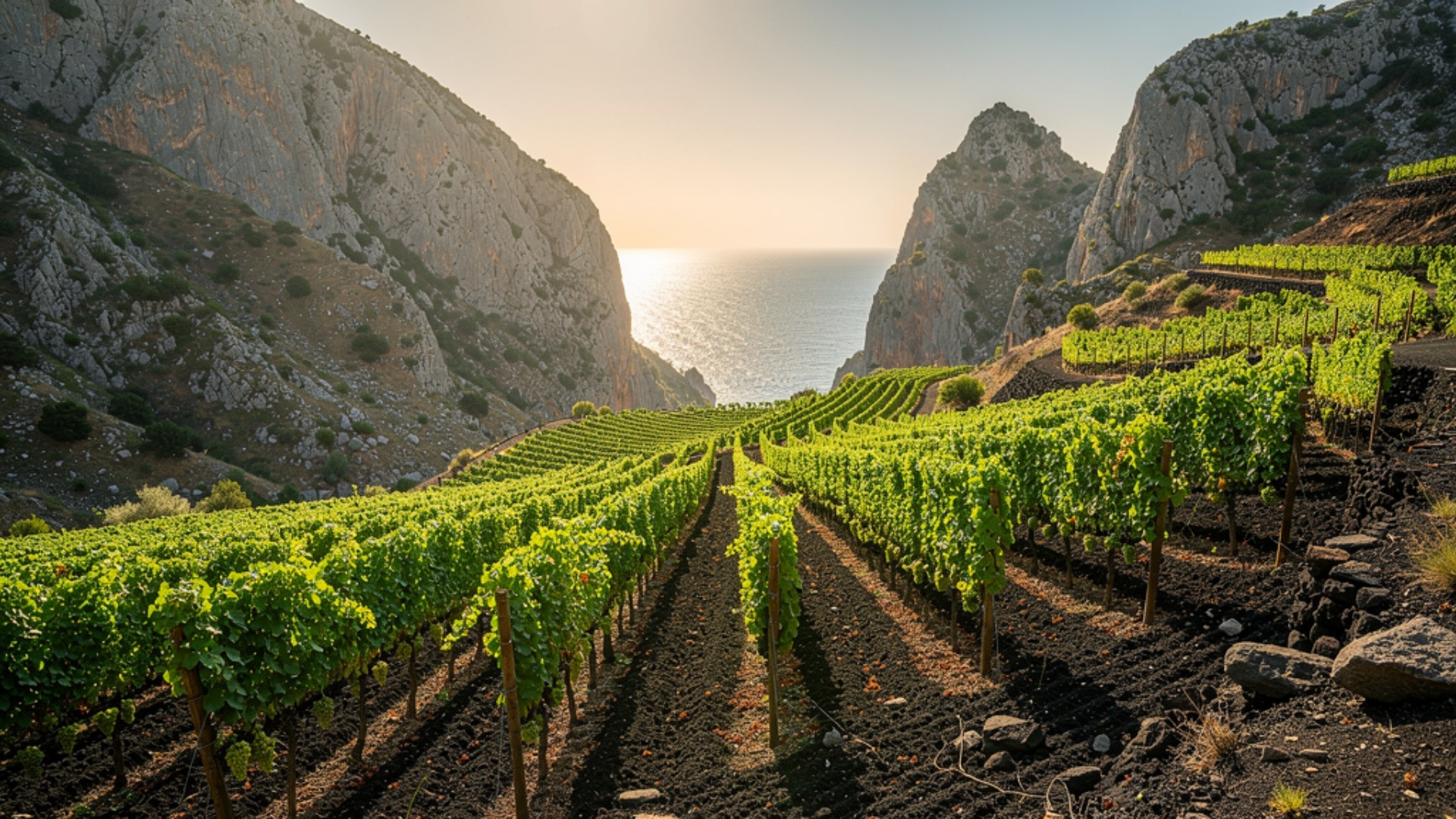

On the eastern edge of Salina, Antonino Caravaglio farms vines across four Aeolian islands, Salina, Lipari, Vulcano and Stromboli. He took over the family holding 35 years ago, when the cellar produced mostly red wine and capers. His Malvasia di Lipari, both passito and dry, now runs to 40,000 bottles a year and travels well beyond Italy. His most singular vineyard sits inside a crater. The Fossa del Monte on Lipari is a 350-metre depression flanked by Monte Guardia and Monte Gallina, where iron and sulphur turn the rock red and yellow, and where temperatures have dropped to zero in April. Italy Now spoke with him at the cellar.
Caravaglio is based in Malfa on Salina, with vineyards across the four central Aeolian islands. The archipelago was Italy’s first natural UNESCO World Heritage site, in part because from a single point three active volcanoes can be seen at once, Stromboli, Vulcano and Etna.
Q. You farm across four islands. Where did it begin?
“The company is based at Malfa, east of Salina. We have vineyards on Salina, Lipari, Vulcano and Stromboli. On Salina alone we work around 10 hectares of Malvasia di Lipari spread across 20 different plots, from sea level up to 400 metres. Aeolian culture is a peasant culture, born of survival. People grew grapes, capers, dried fruit, and traded them for flour and other staples. My family did not own vineyards on Lipari or Salina originally, just a small two and a half hectare holding in the village.”
Q. You were among the first to vinify Malvasia di Lipari as a dry white?
“Malvasia di Lipari has always been the passito, the oldest and most famous wine of the territory. From 2010 we began vinifying the grape without drying. We harvest about ten days earlier than for the passito, around mid-August, then press whole bunches very softly. Fermentation starts on its own after twelve hours and lasts fifteen to twenty days. The wine rests in tank for around a year. The grape has a beautiful natural acidity, which is why even the passito is never cloying. In the dry white, that freshness and minerality becomes the whole point.”
Q. Tell us about the Fossa del Monte.
“It is one of the craters that formed Lipari, between Monte Guardia and Monte Gallina. The depression runs about 350 metres long and a hundred wide. The rocks are not black, they are red and yellow, because of iron, sulphur and other minerals. The islands were formed in different eruptive phases, and each phase left a different mineral composition behind. Inside the crater we have just over a hectare of vines.”

Q. What does that environment do to the wine?
“Wines born on volcanic soil are vertical in the mouth. They keep this tension, this minerality, this salinity. The Fossa del Monte area is so particular that a few April ago my vineyard froze. Temperatures drop to zero, there is a strong day to night swing, the clouds come in with the Ponente (western wind) and settle inside the crater. Even in winter and spring I sometimes cannot see the vineyard for the mist. Japanese visitors once asked if I had driven them to Piedmont by mistake.
And phylloxera never reached these vines. The soil is rich in ash, pumice and sand. Phylloxera has to move through the soil to reproduce, and in volcanic ash the galleries it digs collapse on top of it. So in the Fossa del Monte area we still have pre-phylloxera vines. We restored an old parcel in 2017 and it came back into production in 2019. From those very old vines we make 1,500 bottles of Corinto Nero a year, and another 4,000 from younger plants, between 10 and 30 years old, under our Nero do Monte label.
Q. Where does Corinto Nero come from?
“It was brought to the Aeolians by the Venetians in the second half of the 1600s, when they were pushed out of the eastern Mediterranean. The last island they farmed was Candia, today’s Crete. They left Crete and brought the vines to Salina, which had been uninhabited for almost four centuries because of pirate raids. They rebuilt the first settlement and named it Santa Marina di Salina, after Santa Marina di Bitinia, one of the two patron saints of Venice along with San Marco. They are the ones who introduced Malvasia too.”
Q. What does the Corinto Nero taste like?
“Silky. The tannins come from the skin, not from seeds, because Corinto is a seedless grape with a thick skin. Those skin tannins give the wine its silkiness and finesse.”
Q. You also have a project with Château Palmer?
“In 2024 we made two cuvées with them from Salina Malvasia. One from vines along the cliffs at 100 to 130 metres above the sea, which we called Punta Capo, the other from 30 year old vines at 400 metres. Same grape, same vinification, eight-hundred-litre wooden barrels for both fermentation and ageing. The point was to see how Malvasia di Lipari, which is a variety that gives way to the territory rather than covering it, captures two very different sites. That deference to the land is one of the great qualities of this grape.”
Q. Where does the wine go, is it purchased internationally?
“The Malvasia makes up about 80 percent of our production, split between the passito and the dry wine. When I started 35 years ago it was almost impossible to sell wine in Italy if you were not a known producer, so we exported. We began with about 80 percent of our bottles being sold abroad. Today we are 60 percent in Italy and 40 percent abroad.”
Q. Your grandmother was born in America?
“She was born in Boston in 1898. Her father had emigrated after the phylloxera crisis. She came back to Salina aged seven, and her memories were vivid. She used to tell us about the sacrifices of leaving a small island for the north of the American continent.”
Q. Are people that moved out starting to return to these islands?
“There is a return, but a gradual one. I have felt it across the last twenty years, not just the last five. When I started in the early 1980s, there were very few if any were bottling and exporting. But those that did showed us that a farming life could pay. Today we are about 15 producers. More than 30 percent of our cellar visitors are women between the ages of 30 and 40, drawn by organic farming, indigenous grapes and a territory that is unmistakably itself.”
Q. What are those visitors looking for?
“Not the best wine in absolute terms. They are looking for the wine that is the best expression of the place they are standing in. Organic farming, an indigenous grape and a singular territory help us deliver that.”