

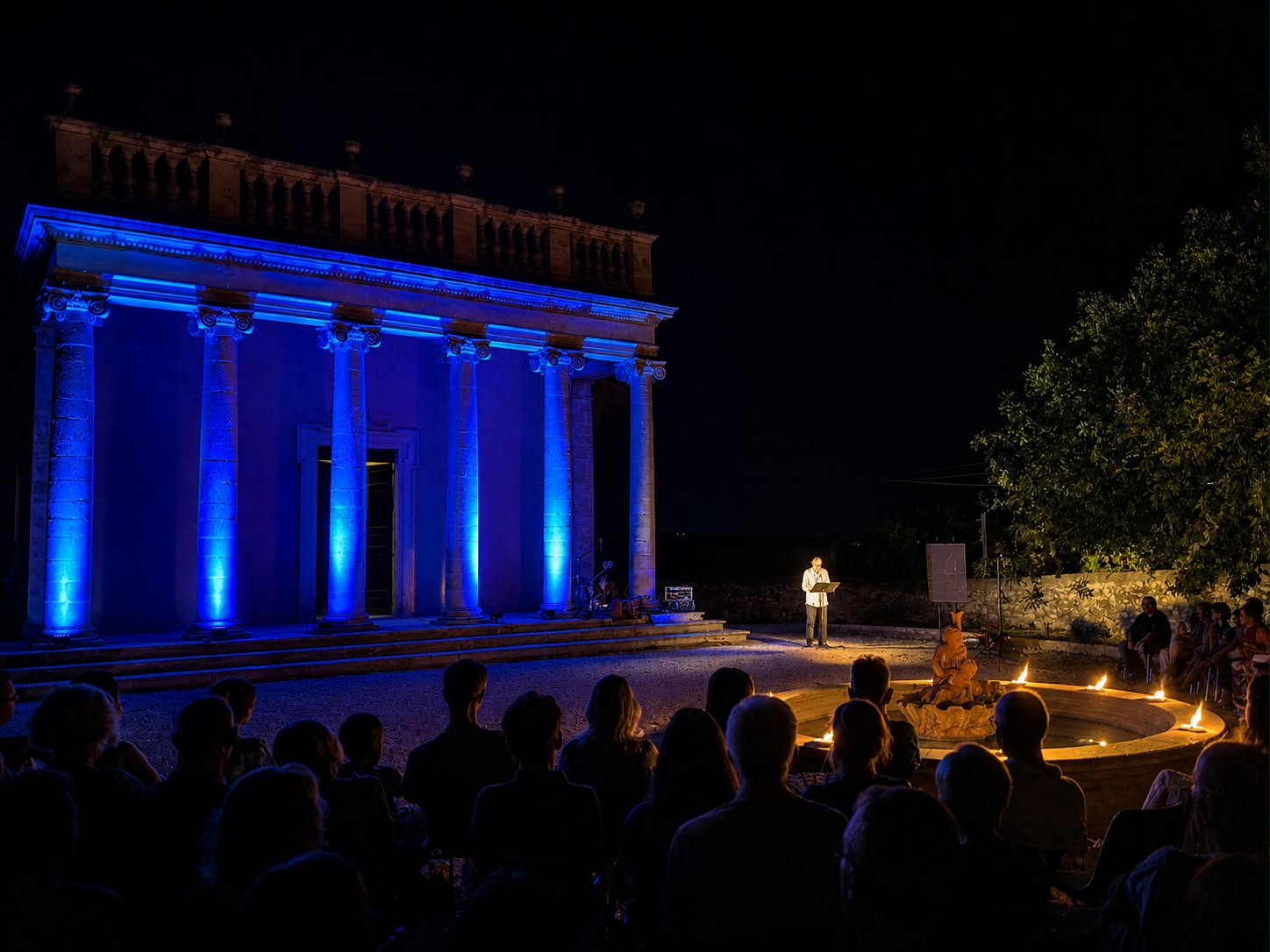
RAGUSA — Two sold-out nights, with the opera star Plácido Domingo as honorary president, brought Giovanni Verga’s stark Sicilian realism to the Castello di Donnafugata near Ragusa on July 21 and 22, 2026, before the production’s tour moved on across Sicily.
The opening night, July 21, gave Gramigna its world premiere, written and directed by Lorenzo Muscoso from some of Verga’s most unsparing tales. Verga, the 19th-century writer whose work defined Verismo (Italy’s answer to literary naturalism), was staged by Jacopo Cavallaro, known for Italian television and film, Greta D’Antonio, trained in Syracuse’s Inda theatre, and Alessandro Sparacino.
“They were two magical evenings devoted to Verismo,” said Muscoso, the festival’s director, “with hundreds of people at the Castello di Donnafugata making every moment intense and moving.”
The response in the hall was warm. “It was really moving to be here,” one spectator said, “the actors were excellent and the rewriting reflects contemporary society with real force.”

Honorary president
Domingo, honorary president of both the festival and its parent body Verga100, was described by Muscoso as the first artist to enter the history of the Cavalleria Rusticana opera prize. His association, the director said, lent the edition further prestige.
On July 22 the festival staged Don Gesualdo, with Sparacino in the title role and original music by Riccardo Gerbino, tracing the ambition and isolation of Verga’s self-made protagonist. “It is the third time I have seen it,” one returning spectator said, “and each time I am moved by events that still feel close.”
The production was supported by the Comune di Ragusa and produced by Dreamworld Pictures and Verga100. The Verghiano programme continues into August, with a repeat of Gramigna on August 9, a Cunziria Festival pairing Verga with the Nobel-winning Sicilian playwright Luigi Pirandello, and a satirical comedy in Ragusa in mid-August.
The setting

The Castello di Donnafugata sits about 15 kilometres from Ragusa. Despite the name, it is not a medieval fortress but a late-19th-century neo-Gothic residence restored by the city after 1982, its halls a regular draw for film crews from Il Commissario Montalbano to Roberto Faenza’s I Viceré.
The first evening also marked the recovery begun in 2013 at the Cunziria, the abandoned borgo (a small historic village) tied to Verga’s Cavalleria Rusticana and, in Muscoso’s words, a symbol of Verga’s world. For two nights, the castle itself became part of the story it helped to tell.