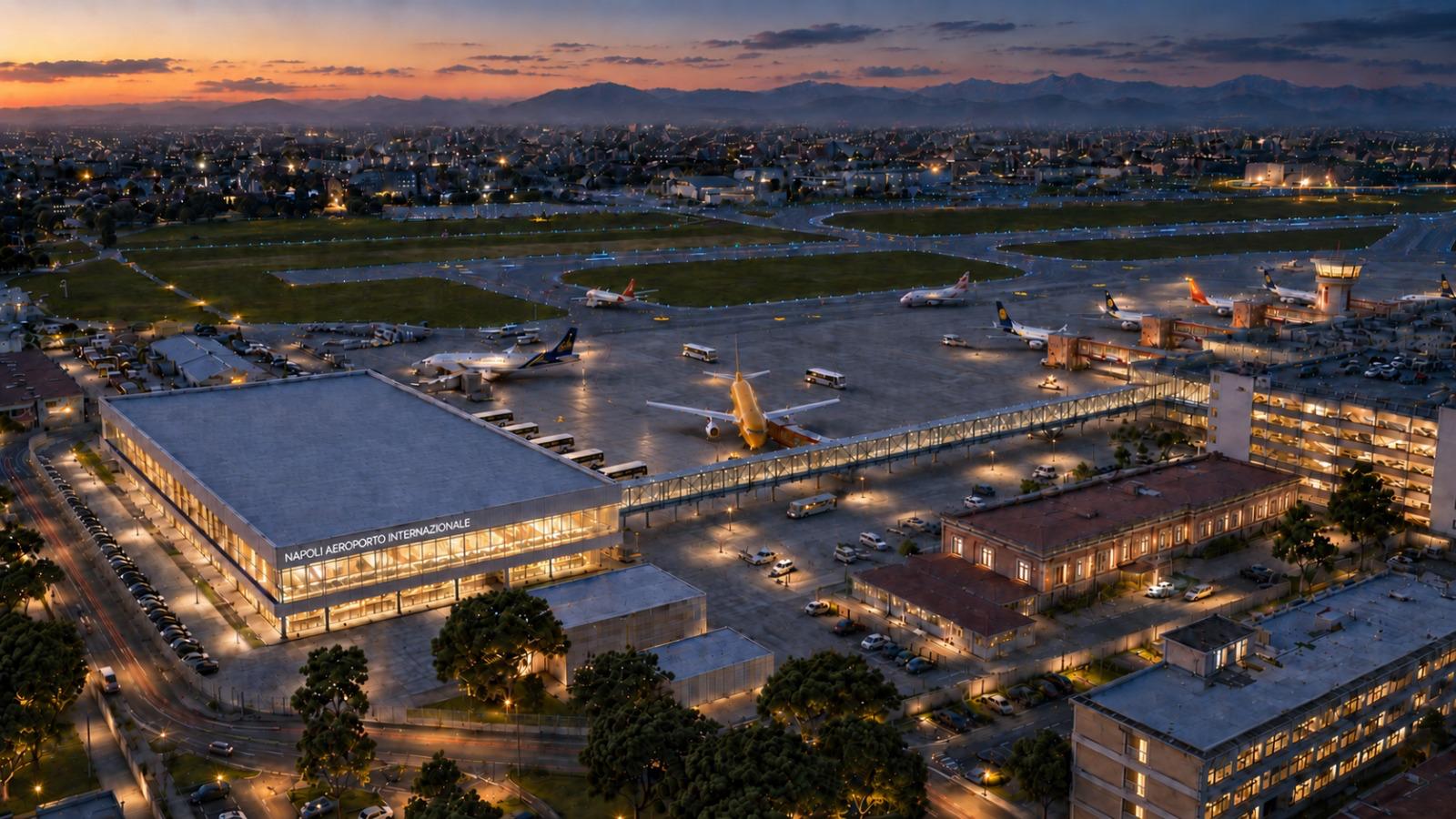

NAPLES Naples’ Capodichino airport is set for a 250 million euro transformation by 2035, after ENAC (Ente Nazionale per l’Aviazione Civile), Italy’s civil aviation authority, approved a major masterplan unveiled by regional and national officials on September 14.
“With the new Capodichino masterplan we are redesigning the future of Naples’ airport, and at the same time carrying out an important work of urban regeneration for the neighborhood and the city,” said Roberto Fico, president of the Region of Campania.
The plan, developed by GESAC, the company that runs the airport, calls for a new terminal of about 15,000 square meters for extra-Schengen flights, those arriving from outside Europe’s open-border zone, plus a new cargo and logistics area, a new airport hotel and roughly 170,000 square meters of newly acquired land. Of the total investment, 230 million euros comes from private funds, and more than 13 million euros is earmarked for environmental measures.


Growth without crowding
The masterplan projects growth to 17.3 million passengers a year by 2035, up from about six million when F2i, a major Italian infrastructure investment fund, first invested in GESAC, according to Renato Ravanelli, F2i’s chief executive. Officials say the increase will come from larger aircraft, fuller planes and better scheduling, not from raising the airport’s current hourly capacity.
“The strategic value of the Masterplan should be assessed in terms of the airport’s contribution to the productivity and competitiveness of the wider metropolitan economy,” economist Stefano Monti told Italy Now. It “represents a significant opportunity to strengthen Naples’ international connectivity.”
The real test will be to see “how effectively this additional connectivity can translate into higher-value tourism, business flows, international investment and knowledge exchange across Campania,” Monti, who is a partner at Monti&Taft, added.
Carlo Mearelli, ENAC’s special commissioner, said the plan fits the national aviation authority’s wider strategy for modern, competitive airports, calling Naples “one of the Mediterranean’s main gateways.” Roberto Barbieri, GESAC’s chief executive, said the investment reaches beyond the airport’s fence, aiming to make the surrounding neighborhood more comfortable for residents, not only for passengers.

Reclaiming the street
A large share of the works targets Viale Maddalena, the road bordering the airport, which will be moved underground to free up space for a new ring road, green areas and cycling and pedestrian paths linking the neighborhood to the city’s metro network.
“A strategic junction will be the opening of the new metro station that will finally connect Capodichino to Central Station,” said Gaetano Manfredi, mayor of Naples.
The airport’s growth already helped Naples become one of Europe’s fastest growing tourist destinations in recent years, officials said, and GESAC has separately opened Salerno’s airport this year, creating what F2i calls a single Campanian airport system. Whether the same expansion can also make Capodichino’s home neighborhood more livable, rather than merely busier, is the masterplan’s bet for the coming decade.