

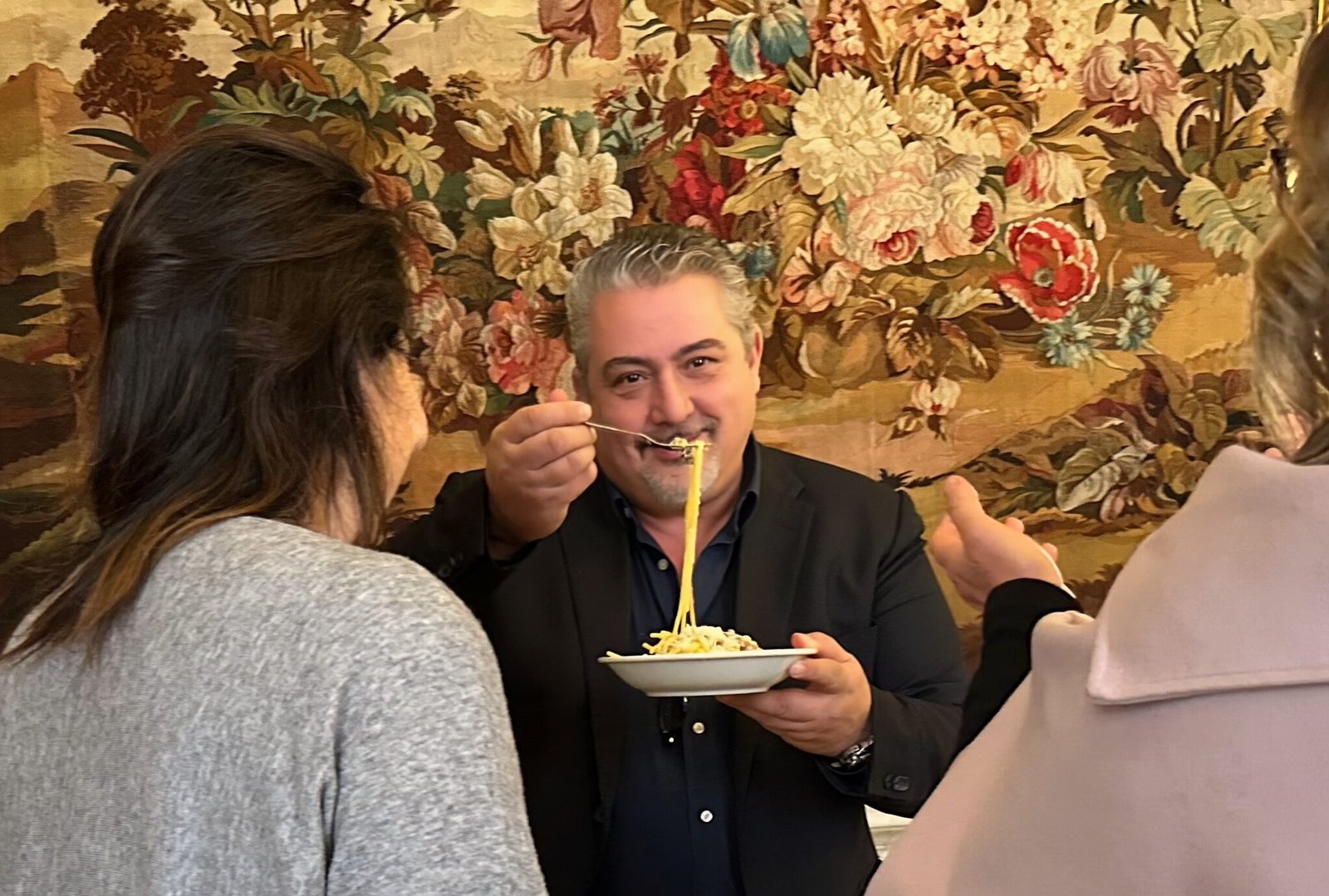

GRAGNANO, Campania — We spoke to Giuseppe Di Martino at his pastificio (pasta production laboratory) in Gragnano, a hilltop town outside Naples. He says the village’s geography, made up a rare confluence of mountain wind, sea air, and light, makes it a place almost purpose-built by nature for the art of drying pasta. His family has been making Pasta di Gragnano IGP here for over a century, using 100 percent Italian wheat, bronze dies, and slow low-temperature drying, across a repertoire of 260 handcrafted shapes. Pasta, Giuseppe says, will never make you rich, but it will never let you go hungry either. This is a philosophy almost old as the town itself, and one the Di Martinos live and work by.
Giuseppe also spoke to us about the logic of shape, about how every curve and ridge exists to give better company to the ingredients it carries. He reflected on the pasta house’s collaboration with Dolce & Gabbana, which gave rise to the Devozione restaurant in New York. And he drew a line connecting pasta to opera, to Puccini, to the San Carlo in Naples, which the pastificio sponsors. All of it, he said, expressions of the same Italian way of living, carried by immigrants to the four corners of the world.
Q. What is it about Gragnano, this specific valley, this air, this water, that has made it the pasta capital of the world?
“Gragnano is a town that was designed by God to make pasta. It’s perfect. It’s got every single natural feature. It’s in the west of Italy, where every day a western wind comes into the town. Using that breeze allows you to dry the pasta gently. Instead of being a dry wind, it’s a moist wind. Perfect microclimate. Also, you’re protected on every side, from the north, east, and south, by the mountains known as the milky mountains. The Romans called them Lactarius Mountains because the milk was fantastic there, due to Vesuvius making the land very fertile and excellent for grass.”
Q. Your great-grandfather founded this company in 1912. It survived two world wars, a massive earthquake in Irpinia, and competition from industrial producers in the north. What is the secret to that kind of resilience across four generations?
“Pasta will never make you extra rich, but it will never make you starve. Even during the Second World War, when there was very little to eat, during the bombing, they were eating pasta that was stuck between the axis of the floor, unreachable by anyone. They had to move the floor, take the pasta, and eat it. So it is a resilient business, produced every day. Gragnano allows you to do it with pleasure because it’s 500 years of experience, shared by my family and thousands of other families in Gragnano.”
Q. Gragnano pasta has IGP status, bronze dies, slow drying at low temperatures, and is made with 100 percent Italian durum semolina. Why does all of that still matter in a world of industrial pasta?
“Making things the right way shows on the final product. Using bronze dies is harder but it scratches the surface, which helps the sauce stick better. Using higher-quality durum wheat improves taste and nutrition. Slow drying preserves the taste and smell of freshly cut wheat.”
Q. Eight million portions a day, over 260 shapes, including some hand-wrapped. How do you maintain that level of craft at such a scale?
“It’s our heritage and our responsibility to protect tradition. The 260 shapes exist because we use different recipes for each shape.”
Q. You have collaborated with Dolce and Gabbana, won the Italian Food Awards in the USA three times, and even have a pasta shape with a Compasso d’Oro nod. How do design and culture feed into a staple food like pasta?
“Pasta has shape to complement recipes and ingredients. It inspires designers, and awards like the Golden Compass recognise its design. Dolce and Gabbana represent Italian fashion; pasta represents Italian food. Their collaboration combines design, fashion, and culinary culture.”
Q. You export 93 percent of your production to over 60 countries, with a pasta bar in New York and a pop-up in Chelsea. When pasta travels, does something get lost, or does the story travel with it?
“Pasta travelled with Italian immigrants worldwide, especially to the Americas. The culture of pasta travels with it because it preserves Italian taste and tradition. It’s consumer-friendly and easy to prepare, but top chefs elevate it. The pasta bars and restaurants teach proper preparation and inspire new generations.”
Q. You sponsor the Teatro San Carlo di Napoli, one of the greatest opera houses in the world. Why that connection between pasta and opera?
“Gioachino Rossini directed San Carlo for a long period. Opera was only called that if sung there. San Carlo is also the name of one of our drying rooms. Everything is linked by taste and the good way of living, much like Italian food and culture.”
Q. What advice do you have for listeners cooking pasta at home?
“Whatever you cook, make it pasta. Al dente, of course. Authenticity is key, and the best of Italy often hides in plain sight.”