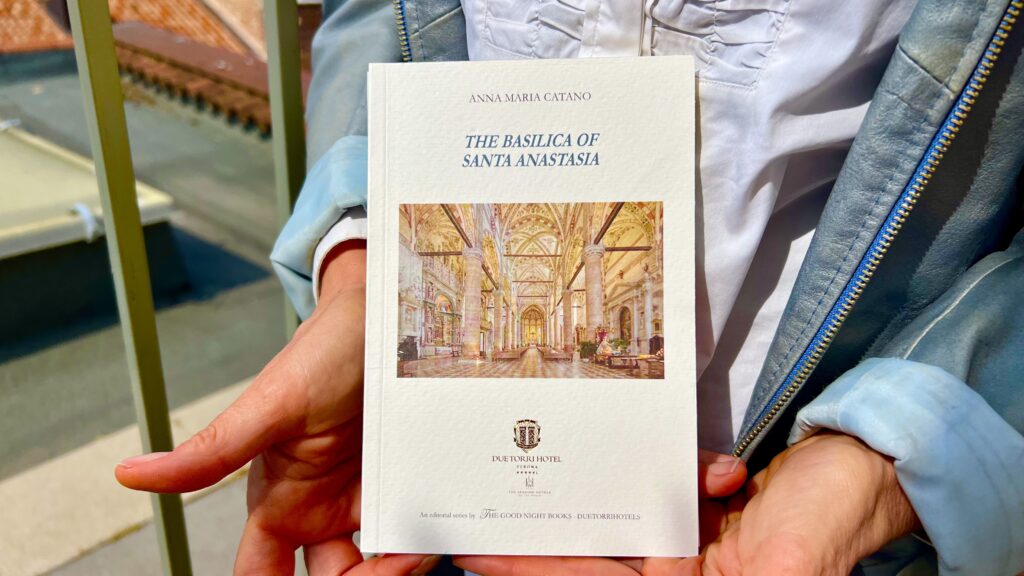
VERONA, Veneto — We spoke to Anna Maria Catano, an Italian journalist and author whose books span travel writing and narrative non-fiction, at the launch of her contribution to the Libri della Buonanotte (Good Night Books) series commissioned by iconic Due Torri Hotels, which celebrates the tenth anniversary of this unique editorial venture this year. The series replaces the classic hotelier ‘goodnight chocolate on the pillow’ with a slim, bilingual volume on a local cultural site or event, written for guests to read themselves to sleep. Catano’s edition focuses on the Basilica di Sant’Anastasia, a Gothic church just steps from the hotel that most visitors walk straight past on their way to Juliet’s balcony, Romeo’s house, and the Arena. Inside, she found a Pisanello fresco that leaves you open-mouthed, a pair of medieval stone hunchbacks that locals have rubbed for good luck for centuries, and a building whose Italian Gothic architecture rivals the great cathedrals of Europe while remaining entirely its own. Physical book sales in Italy are rising modestly but steadily, including among readers under 35, and Catano sees the Libri della Buonanotte format as a quiet act of resistance against the phone, the streaming platform, and the relentless noise of notifications.
Q. The Libri della Buonanotte (the Goodnight Books) format is 50 to 80 pages, too long for a keepsake, too short for a proper book. How did you decide what to leave out?
“This basilica is full of infinite details because it is an extraordinary building that tells the whole story of the city. It was originally a small Lombard church dedicated to Saint Peter, the patron until 1471, when it was consecrated to Sant’Anastasia. Over the following centuries, altars and works of art were added. So the details were truly many. It was a fun piece of work, a series of small stories within a marvellous structure.”
Q. What is inside Sant’Anastasia that most visitors, even well-informed ones, do not know or have forgotten?
“I think most visitors don’t know the structure itself, this example of Italian floral Gothic, with its motifs chasing each other between the naves and the vaults. The spaciousness of this Italian Gothic reflects in some way the verticality of the great European cathedrals, and yet it is completely different. Then there are the two gobbi (hunchbacks). It is a Veronese tradition to touch the hump of these two sculptures, which are actually cariatidi (caryatids) supporting the acquasantiere (holy water stoups), from two different periods. It was a popular tradition: people hoped the ruling lords would give them a little attention, and so touching the hump meant good fortune.”
Q. Was there a detail you discovered during your research that surprised even you?
“Certainly the Pisanello. This is the great fresco considered the masterpiece of Veronese painting of the period. The detail of the princess’s hairstyle, the two hanged men, the animals, the city in the background, the horses. It truly is a fresco that leaves you open-mouthed. Unfortunately it is barely visible because it is very high up. There is actually a video installation underneath that allows you to catch some of the details.”
Q. A book on a hotel bedside table is competing with a phone, a streaming platform, and plain exhaustion. What does a physical book offer that none of those things can?
“A moment of serenity. It is easy, light reading that tells a beautiful story, and in this case the basilica is right next to the Due Torri, the hotel giving out the book. It allows you to fall asleep peacefully, free from the constant bombardment of messages and calls.”
Q. Italian publishers report modest but steady growth in physical book sales, including among readers under 35. Is that a real signal or wishful thinking?
“It is an excellent signal, certainly. The fact that young people have started reading again is wonderful. But declaring victory is very premature. We will see what the future holds.”
Q. The series describes itself explicitly as an alternative to a chocolate on the pillow. Does framing a book as an amenità (amenity) bother you at all?
“Not in the least. I found it a truly commendable initiative, replacing all those semi-useless gadget with something that stays with you. It helps the guest, especially the foreign guest, because the book is also translated into English. It helps them discover the beauty of the city they have come to visit. And it is something that can be put in a library, or carried home across the other side of the ocean as a memento.”