VENICE — We spoke to Gianluca Bisol at Venissa, the walled vineyard on the sleepy island of Mazzorbo that has just been voted second in the 2026 Wine Travel Awards global must-visit public poll, ahead of estates in California, South Africa and France. Heir to Bisol 1542, a Prosecco dynasty with more than five centuries behind it, he rescued the Dorona di Venezia, a golden-hued grape thought lost forever after the catastrophic 1966 Acqua Grande flood. Today, just one hectare of vines inside a 14th-century monastery wall produces roughly 3,500 bottles a year. Each is sealed with Murano glass and labelled in 24-karat gold leaf, hand-hammered by the last surviving battiloro (gold beater) family in Venice. Bottles sell for well above 100 euro.
Q. What’s the history behind Venissa?
“In 2001, I had the opportunity to cross paths with a historic native Venetian grape variety. I came across it in the small garden of a house on Torcello, right in front of Venice’s oldest basilica. I pursued an absolute desire to recover a viticultural history belonging exclusively to the Venetian islands, a native vine born from a natural crossing centuries ago between Garganega and Malvasia Istriana. My determination led me to recreate the cradle of this vine on an island in the Venetian Lagoon, the island of Mazzorbo, famous for its vineyards and its history.”
Q. What makes Venissa so unique?
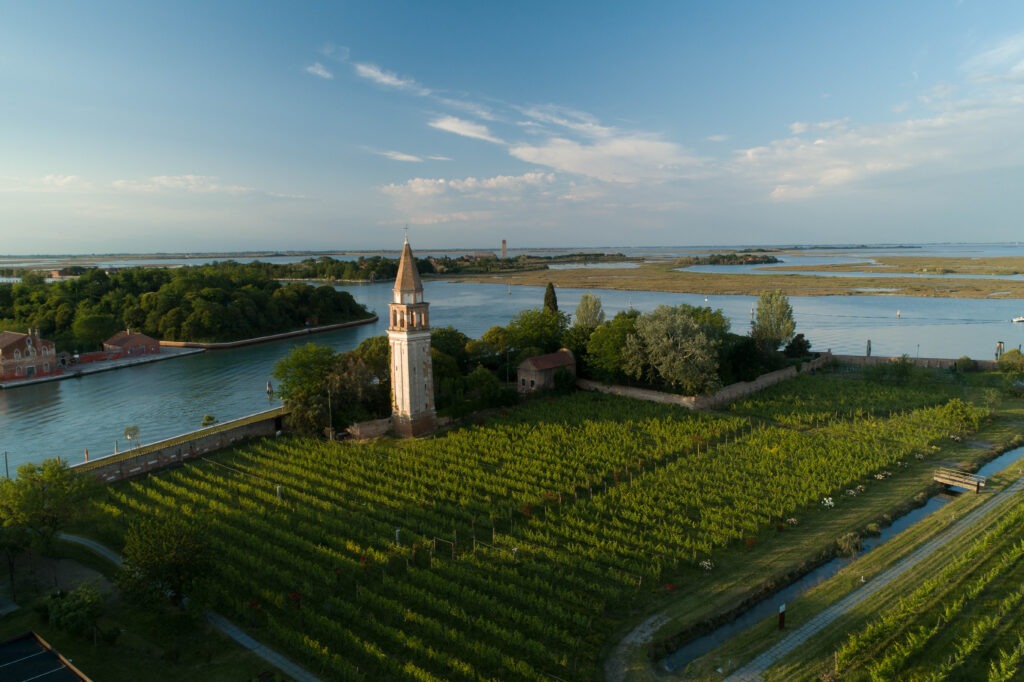
“What makes it unique is the contrast between an overcrowded Venice and a Venice so unique, so quiet, so unexpected. We are used to a Venice that closes our view with walls, high walls, medium walls. The estate of two hectares is enclosed by a wall from the 1300s, rebuilt in the 1700s, so from outside you cannot imagine what could be inside. The surprise when you open that little door and see these two hectares all together in Venice is something completely unexpected. A vineyard on an island in Venice, you do not expect it. Even more so a vineyard enclosed by an ancient wall, although extraordinary examples exist in France, Clos du Mesnil for example, but even more a vineyard enclosed by a wall outside which lies one of the most beautiful lagoons in the world. And then this bell tower from the 1300s rising in the middle of the vines gives everything a surreal feeling. Inside there is a microcosm of vineyard, vegetable gardens and a peschiera, the old fish pond, which creates a beautiful balance, with meticulous care of every detail of the garden. Beyond the wall you glimpse the colourful houses, so wherever you turn your gaze an emotion arrives. This, I believe, makes Venissa unique.”
Q. What makes the wine itself unique?
“Inside this marvellous container, Venissa has created the opportunity to taste one of the rarest wines in the world, because it is the only vineyard whose roots descend just 70 centimetres before continuing sideways. It is a sideways vineyard, which makes it even more interesting. Tasting that wine, so particular, so different, with this frame, looking at the vineyard, the bell tower and the wall that surrounds it, becomes a priceless emotion.”
Q. And beyond the wine?
“All this is further enriched by the extraordinary kitchen of Chiara Pavan and Francesco Brutto every day. And there is the opportunity to sleep facing the vineyard on an island in Venice, an island that once hosted the majority of Venetian citizens and today has just 250. We have gone from 50,000 inhabitants a thousand years ago to 250.”
Additional reporting by Sabina Castelfranco