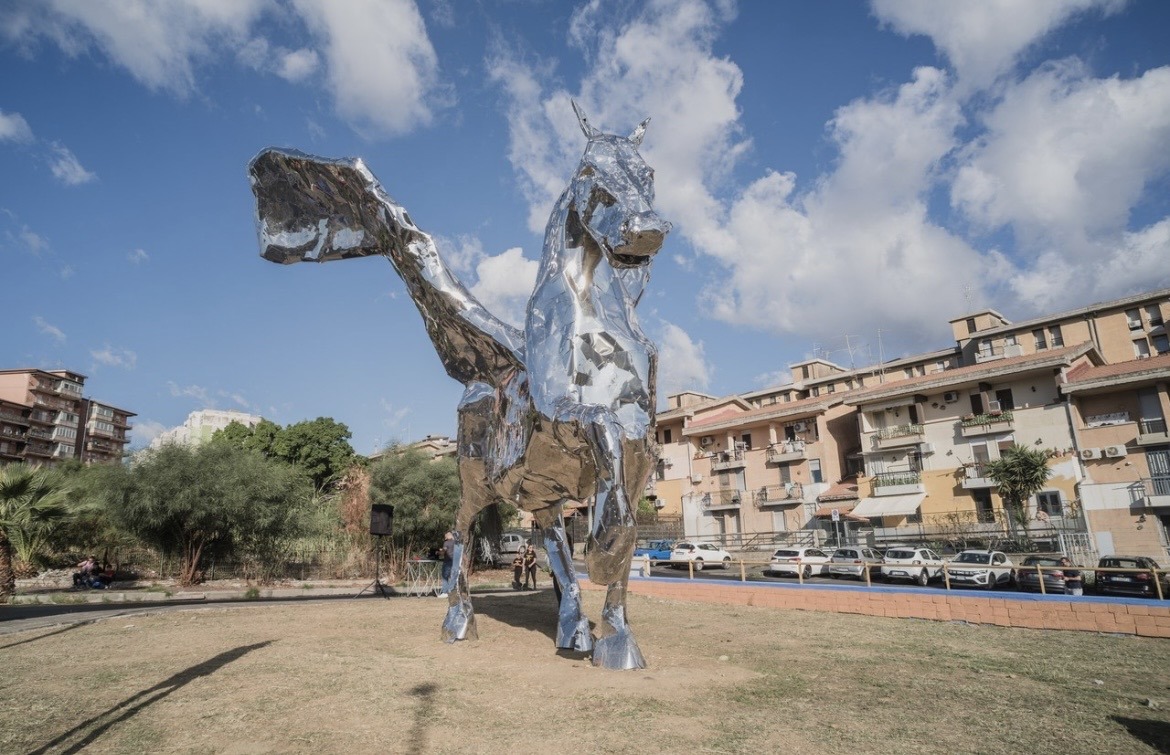

CATANIA, Sicily — Sicilian artist Antonello Bonanno Conti’s Pegaso (Pegasus), a winged horse clad in mirror-polished steel, was unveiled on October 13 in Librino, a satellite district on Catania’s southern edge, as a symbol of hope for its children. Keeping it cared for is now the test.
Pegaso stands in the square in front of the Campanella Sturzo school on Viale Bummacaro. It joins MAGMA, the open-air museum that the Fondazione Antonio Presti has spread across Librino’s walls, overpasses, and roundabouts.
“In Librino we freed the horse from the weight of the cart,” Antonio Presti, the Sicilian patron behind the foundation, told La Sicilia, “and today, by giving it wings, we want to entrust it with the dreams of the children and mothers of the neighbourhood.”
Poet Maria Attanasio attended the ceremony. The work cost 100,000 euro.
Steel and rivets
Bonanno Conti shaped the horse from cardboard, wood, and metal mesh, then clad it in stainless steel sheets 0.8 millimetres thick. Tens of thousands of rivets, set by hand, hold the skin together without a single weld.
“I imagined a sculpture of light,” the artist said, “capable of reflecting the beauty of the immense and appearing as a living presence.”
In Catania the horse carries heavy local meaning, from the horse-meat butchers of Via Plebiscito to illegal street races and unlicensed stables. Presti says Pegaso is meant to free that image.

The terracotta pieces around the sculpture form La Porta di Pegaso (the Gate of Pegasus). About 5,000 pupils each modelled one, and about 10,000 pupils from nine schools took part overall.
The method dates back to 2009, when 2,000 children and 2,000 mothers tiled a wall to create the Porta della Bellezza (the Gate of Beauty).
The harder test
Japanese architect Kenzo Tange designed Librino in 1970 as a self-contained modern quarter, but much of his plan was never built, according to a University of Palermo study. About 70,000 people live there, according to Istat, the national statistics institute.
Under a March 1 addendum, Catania pledges design support, free use of public land, and an evaluation of water and electricity connections. The truer measure comes in the months that follow, when it becomes clear whether the square stays clean and lit. In a district so often described by outsiders, a monument that shows residents back to themselves may be the most pointed idea of all.