MILAN — Milan’s Ancient Egyptian Collection reopened March 5 at the Castello Sforzesco after a decade of remodelling, research, and restoration. Its some 3300 artifacts, which include coffins, amulets, ushabtis, small bronze sculptures, papyri, mummies, canopic vases and steles illustrate every period of ancient Egyptian history from 4000 BC to 500 AD. Eighty of the 330 artifacts on display have never been exhibited before.
“We are giving back to our city of Milan, to its citizens, but also to other Italian and international visitors, a cutting-edge layout of our Collection, one super-qualified to tell the multi-millennial history of ancient Egypt, its daily life and its afterlife, the worlds of its people and of its gods,” said Tommaso Sacchi, Milan’s Cultural Commissioner.
A temple-inspired space
Its innovative lighting which turns off automatically if a room becomes visitor-free, its multi-lingual audio-guides, didactic videos, thematic wall panels, and touch screens are all state-of-the-art. Especially evocative is its new room, designed by Austria-born, Merano-resident architect Markus Scherer, inspired by the hypostyles (grand column-line halls) of ancient Egyptian temples, with its ceiling-high monumental glass column exhibition cases.
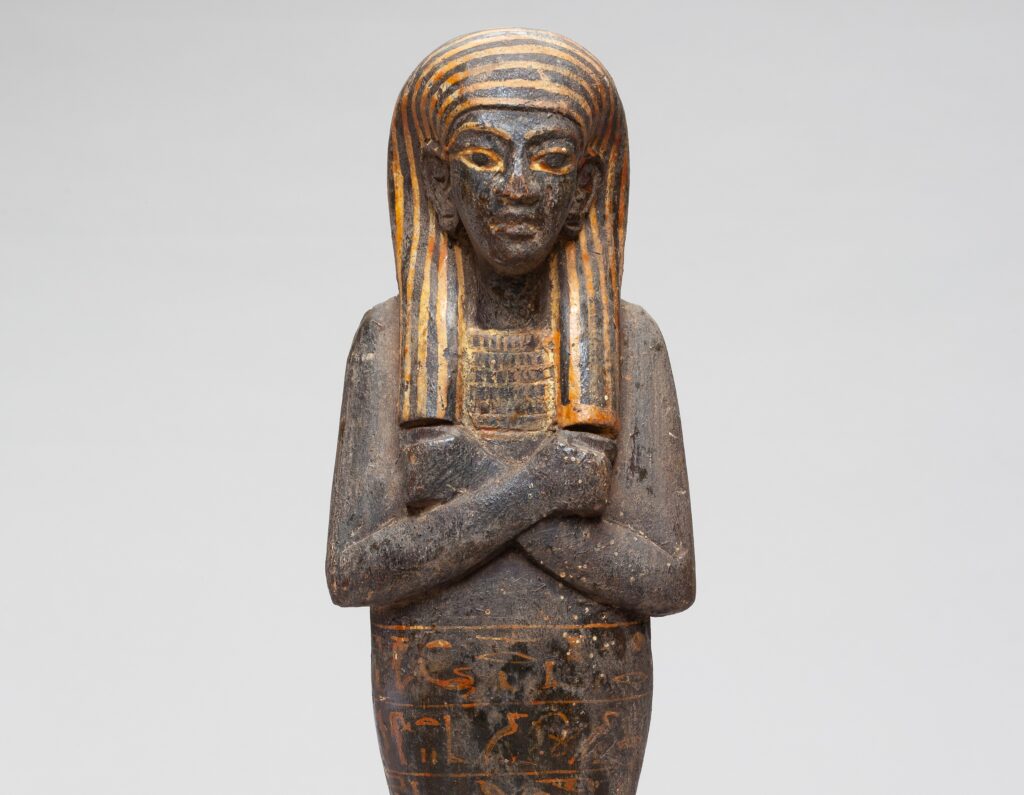
The layout is divided in six sections: Life in Ancient Egypt, The Afterlife, The Gods, Excavations sponsored by the University of Milan, Daily life and religion in Greek and Roman Egypt and Coptic Egypt.
A collection two centuries in the making
Milan’s Egyptian Collection originated, like most of Europe’s, in the early 19th century at the height of Egyptomania. It gradually grew thanks to donations, targeted acquisitions, and finds from the excavations conducted in the 1930s in the Fayum, specifically at Medinet Madi, by Milanese professor and papyrologist Achille Vogliano. Here he discovered an enormous temple complex with two seated Pharaonic statues.
“One, the statue of Amenemhat III (1842-1794 BC), although badly damaged,” curator Sabrina Ceruti told the press, “is one of the Collection’s two stars, other highlights Vogliano uncovered here are: the base of a stela dating to the reign of Rameses II (1279-1212 BC), a Ptolemaic head of a sphinx and a statue of a priest from the Roman period.”
“The collection’s other star: a small bronze statue of the god Osiris, dating to the sixth century BC, came to Milan through Pietro Ruffini’s donation of his private collection in 2013.”
Open Tuesday-Sunday 9.30 a.m.-5.30 p.m. Entrance fee: 5 euro, 3 euro reduced.