VENICE — As the 2026 Venice Biennale unfolds across the city, the Arsenale section offers the most immersive and politically charged experience. Across vast former shipyard spaces, war, climate, technology, and migration surface repeatedly through sound, light, and materials drawn from extractive economies and contested geographies.
The former shipyard of the Republic of Venice, the Arsenale hosts monumental installations, videos, panels, and immersive structures that engage not only the eye, but also smell and hearing. Ancestral knowledge and imagined futures are woven together in ways that feel urgent and speculative.
Four installations
The first encounter is a dark room filled with a babble of voices. Lawrence Abu Hamdan uses sound as political evidence, exploring surveillance and state violence through echoes, noise, and gunshots that hold visitors in place. That atmosphere of stillness and grief evokes Elegy by Gabrielle Goliath, a collective mourning ritual for victims of violence.
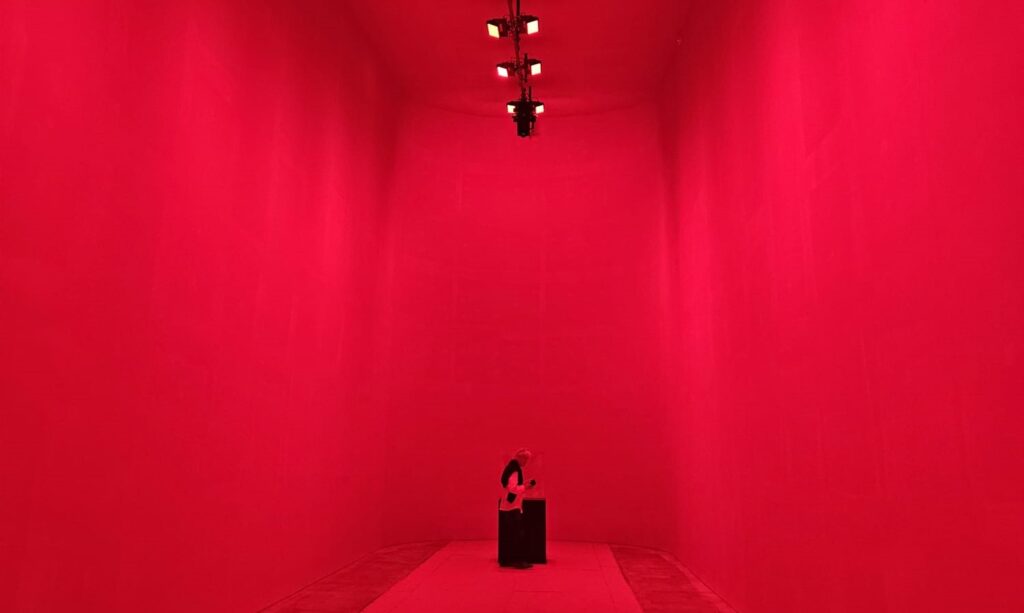
The End of the World by Alfredo Jaar occupies a large hall accessed through a heavy curtain. Inside, the room is bathed in red light and filled with a metallic smell that makes the space difficult to inhabit. At the back, a display case contains a cube formed from cobalt, lithium, manganese, copper, coltan, and tin, materials bound to extractive economies and geopolitical conflict.
Visitors are drawn to the beauty of the olive tree in Garden of the Broken Hearted by Theo Eshetu. Set on a rotating platform and illuminated by footage captured before its uprooting, the tree becomes a meditation on impermanence, mourning, and forms of violence that many people encounter only through screens.
From destroyed mosaics to open questions
The Saudi Arabian Pavilion is especially striking. “I reinterpret mosaics from 23 archaeological sites destroyed by conflict, commissioning 29,221 handmade tiles for my artwork May Your Tears Never Dry, You Who Weep Over Stones,” Dana Awartani says. She describes the work as a meditation on loss, memory, and the meeting point between craft and contemporary art.
Other notable pavilions include those of Mexico, Morocco, and the United Arab Emirates. Each offers a different story, yet all contribute to a wider invitation to listen, reflect, and reconsider. What distinguishes this year’s Arsenale is its insistence that looking is not passive, each work asks visitors to consider their own position within the forces being mapped.