


VENICE — Across several pavilions at the2026 Venice Biennale, the idea of home surfaces again and again through video, painting and, above all, installation. Home is not always where we live. It can be a place left behind, a memory preserved, or a space rebuilt through emotion and imagination. For those at a distance, it becomes less a fixed address than a portable condition: ritual, memory, transformation, myth.
Thread, clay and the architecture of memory
India’s national pavilion, Geographies of Distance: Remembering Home, brings together five artists from different parts of the country. Clay, thread, bamboo and papier-mâché become carriers of memory and place. In Permanent Address, Sumakshi Singh rebuilds her demolished family home in New Delhi at life size using thread alone. The structure appears fragile and spectral. “The work is ethereal and insubstantial, like a memory,” Singh has said of the piece. Memory and home are also evoked through flowers and works that move between nature and spirituality, in the installations of Ranjani Shettar.

At the opening, Union Culture Secretary Vivek Aggarwal described the exhibition as bringing together artists “whose work engages with memory, material and transformation, while opening a broader reflection on belonging and identity.”
At the UK Pavilion, Lubaina Himid poses a parallel question: how is a new home imagined after migration or war? The pavilion has a theatrical energy. Himid’s paintings, with their saturated colours and absorbed figures, are threaded through with questions of history, colonialism and memory.
Ruins, graffiti and the weight of divided history
The German Pavilion arrives with particular force. Wrapped in three million mosaic tiles and layers of graffiti, it recalls the prefabricated housing blocks built for Vietnamese workers in the GDR, the environment in which artist Sung Tieu also grew up. The intervention carries additional weight inside a building still shadowed by Hans Haacke’s 1993 act of smashing its marble floor.
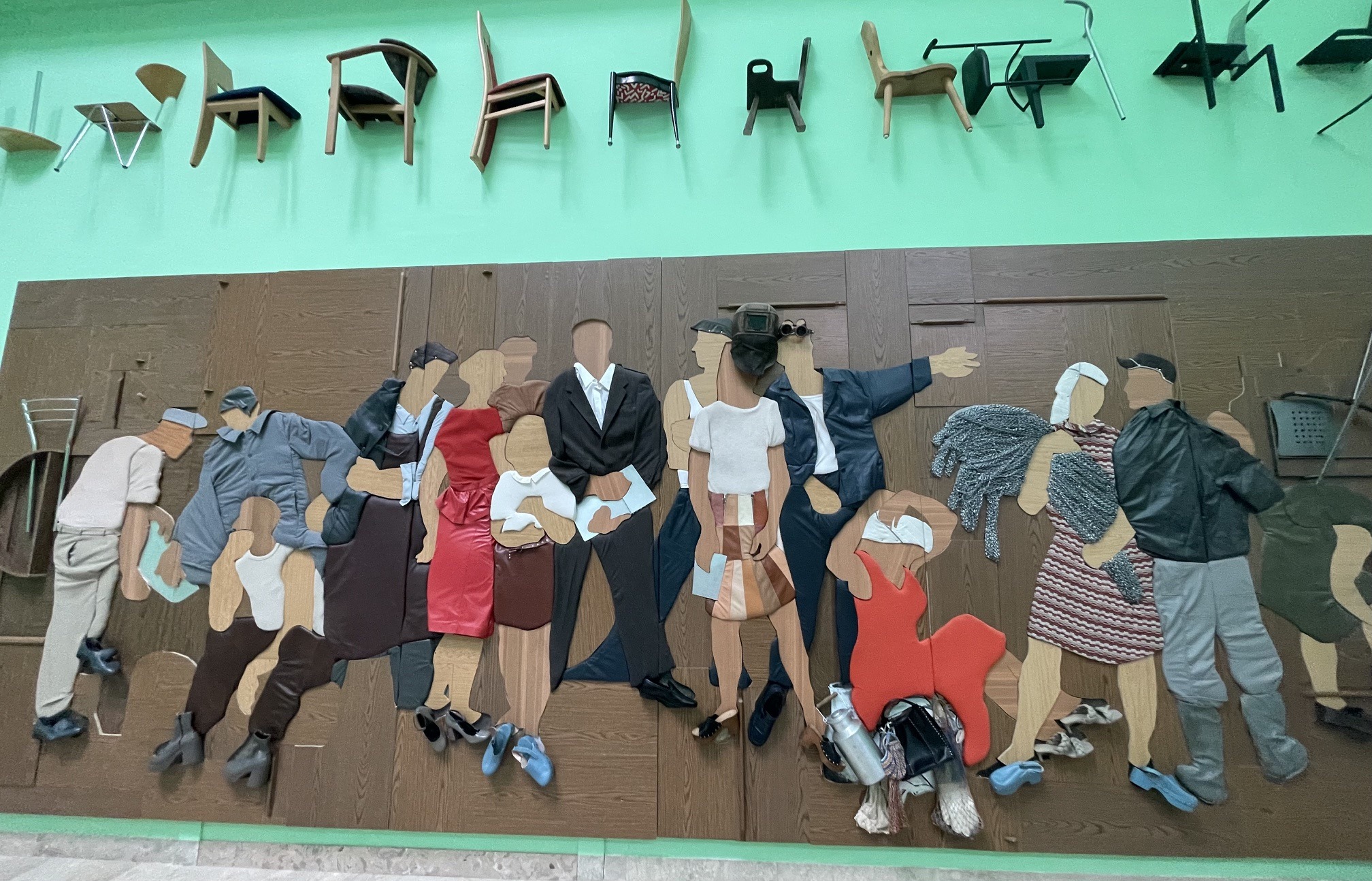
The exhibition, Ruin, examines the fault lines between East and West, migration and the afterlife of history. Curator Kathleen Reinhardt brings together two women artists shaped by the GDR and by the disruptions that followed German reunification. Henrike Naumann addresses the West’s aesthetic colonisation of the East through an installation of period furniture and objects she describes as “the archaeological prehistory of the present.” Sung Tieu, drawing on her Vietnamese migrant background, turns to Vietnamese lives in Berlin. Reinhardt leaves the viewer with a final question: in a moment when crisis feels omnipresent, can ruins still be seen romantically?