VENICE — Ten thousand visitors flocked to the Giardini on May 9, the opening day of the 2026 Venice Biennale. In sweltering heat, queues stretched for up to two hours outside the Austrian Pavilion, where Florentina Holzinger’s performance drew some of the longest waits of the day. Her work is physical, explicit and confrontational, and nudity plays a central role. Visitors who emerged reported stays ranging from five minutes to two full hours.
Austria and Denmark: provocation as crowd-puller
Since Hermann Nitsch and the Viennese Actionism movement, Austria has built a reputation for sending artists who work deliberately with nudity, religion, sexuality and political criticism. Holzinger fits squarely in that tradition.
Crowds are also forming at the Danish Pavilion, where the exhibition Things to Come takes as its starting point an unexpected finding from a Danish sperm bank: viewing pornography in virtual reality can increase human sperm motility. The show uses that observation to examine fertility, technology and the human body. One room screens a video featuring porn actors cast as scientists; another holds containers used for transporting semen. “I see the fertility crisis as a symptom of a broader condition,” said artist Maj Malou Lyse.
Coexistence, care and the politics of family
The Swiss Pavilion, Unfinished Business of Living Together, takes a quieter but no less pointed approach. The work revisits a 1978 Italian television talk show, Teleareno, which sparked widespread public debate when it addressed homosexuality for the first time on national television. Artists Gianmaria Andreetta, Luca Beeler and Nina Wakeford use that moment as a lens for examining LGBT issues and coexistence in pluralistic societies today.
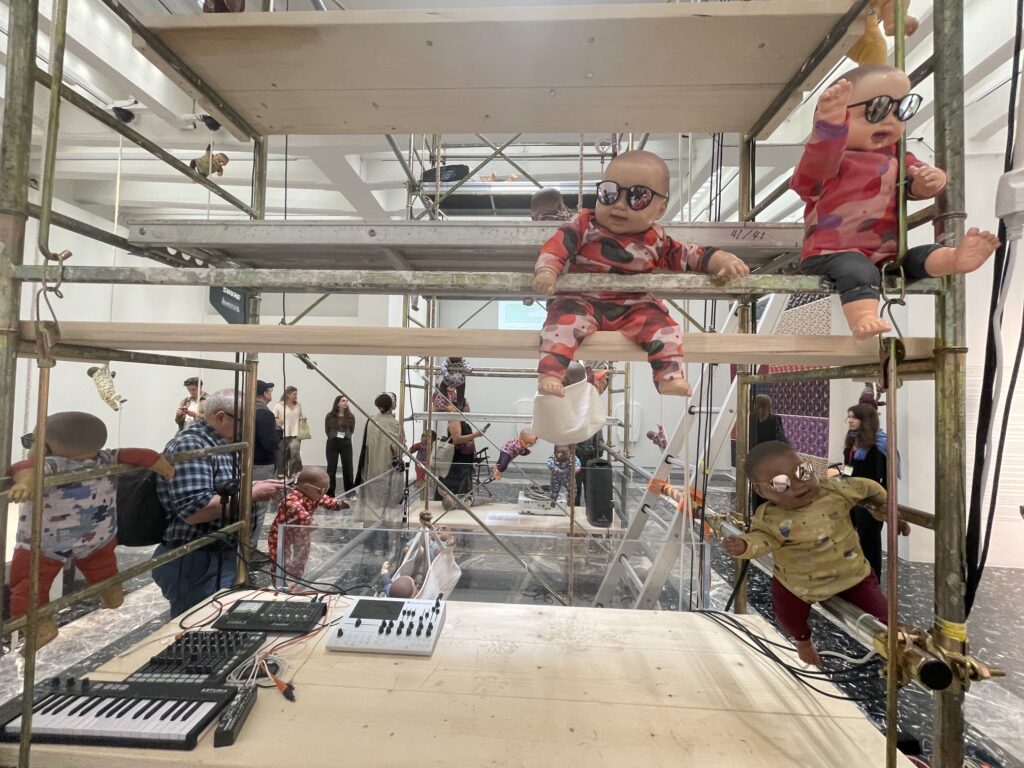
The Japanese Pavilion offers the most unexpectedly joyful experience of the Giardini. Visitors queue amid baby dolls and prams before being invited to hold and care for weighted four-month-old dolls. When a nappy is changed, a QR code appears that, when scanned, generates a poem for the baby’s birthday. Artist Ei Arakawa Nash, who has adopted twins with his queer partner, designed the piece to prompt reflection on care and affection. “They’re quite nice and heavy,” said Victoria Smith, 60, who returned a second time to bring a friend. The dolls, known as Grass Babies, all wear sunglasses, mirroring back the expressions of the people holding them.