


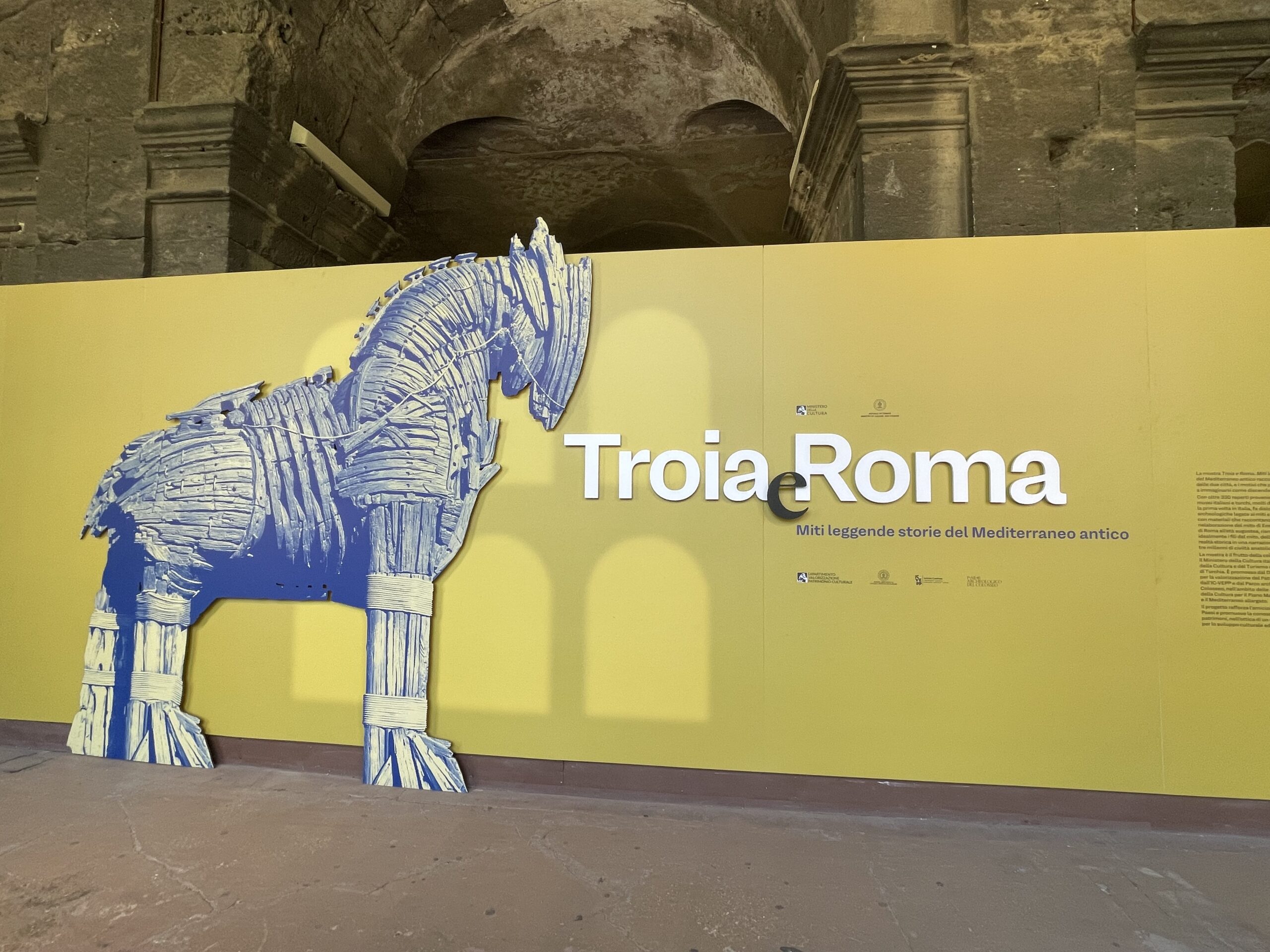

ROME — At the Colosseum, one of Rome’s most visited monuments with more than 12 million visitors a year, a landmark exhibition on the second level on the building, is tracing the story of Troy from Bronze Age Anatolia to the founding myths of Rome itself. Italy Now spoke with one of the curators Alessio de Cristofaro about what it means to separate legend from archaeology, and why both matter.
Q. You describe the exhibition as a great fresco. What do you mean by that?
“For the first time in Italy, we have told the full archaeological and historical story of Troy, not just from Schliemann’s excavations onward, but in close collaboration with our Turkish colleagues, who helped us portray the full arc of Anatolian civilization in the third and second millennia BC. We wanted visitors to understand something fundamental. Troy is not only a myth, not only Homer. It is a real archaeological site, a principality of ancient Anatolia with a rich life from the Bronze Age through the Iron Age, all the way to the Byzantine period.”
Q. How did you handle the tension between myth and history for a general audience?
“With great difficulty. We tried to make clear that myth and archaeology never coincide, they are two parallel narratives, each requiring its own tools of interpretation. For the ancients, myth was not a fairy tale or a moral lesson in the Enlightenment sense. It was a way of thinking about reality, as legitimate in its own domain as scientific or historical reasoning. One does not replace the other.”

Q. What objects stood out as key to the exhibition?
“A clay tablet on which the name of Troy appears for the first time in written form, in the variant ‘Wilusa,’ from which our word ‘Ilion,’ and then ‘Troy,’ derives. Our Turkish colleagues generously agreed to lend it, as it rarely leaves the museum where it is kept. It is the archaeological proof of a real, historical Troy, not just a Homeric one.”
Q. And the second half of the exhibition follows Aeneas?
“Exactly. In Homer, Aeneas is a minor figure, but a prophecy assigns him the task of reviving Troy’s greatness after its destruction. We follow his journey across the Mediterranean with a focus on the sanctuary of Athena at Castrum and new finds from the necropolis of Santa Palomba, identified as the burial ground of the Alban princes from whom, legend holds, Romulus and Remus descended. We tried to give historical and archaeological substance to what is also, undeniably, one of the great founding stories of Western civilization.”


Conosco molto bene la giornalista Benigna Mallebrein. Nei sui articoli adotta sempre un linguaggio scorrevole e conciso. Come anche in questo articolo molto molto interessante.