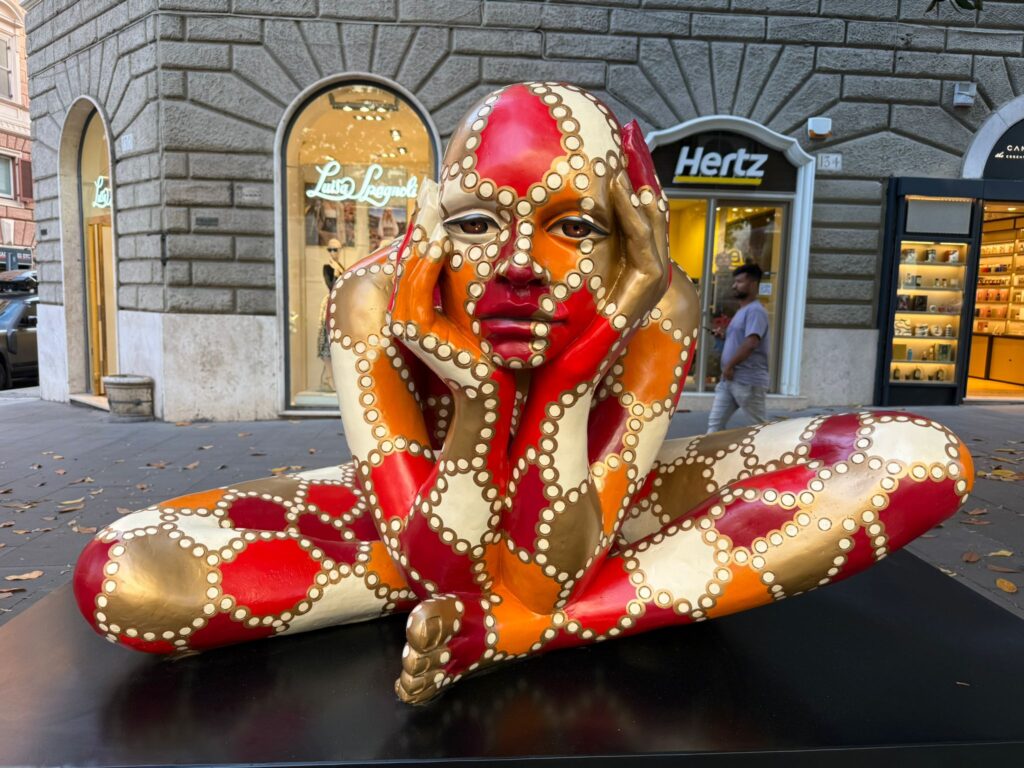
ROME — Under the plane trees of Via Veneto, the Italian boulevard immortalised by Fellini’s “La Dolce Vita”, defence minister Guido Crosetto paused on May 14 to walk among twenty sculptures by Rabarama, the Roman artist whose figures are covered in runes, letters and geometric script. The open-air show “Armonie del Corpo“, (Harmonies of the Body) inaugurated that evening in Largo Federico Fellini, runs until June 30 and is the latest attempt to turn one of Rome’s most famous streets back into a destination beyond its postcard reputation.
The show, organised by Artevents Mazzoleni and backed by the Lazio region and Roma Capitale’s Municipio I, features Rabarama’s signature human figures, including “Madama Butterfly”, a kneeling form turned skyward in homage to Puccini. The artist, born Paola Epifani in Rome and based in Padua, has exhibited monumental work in Paris, Florence, Cannes, Miami and Shanghai.
For Via Veneto, long faded from its 1960s heyday of paparazzi and film stars, the sculptures are part of a slow rebrand, an attempt to pull the street back into Rome’s living cultural conversation rather than its nostalgia.
Crosetto spoke to Italy Now on art when he entered the Artevents gallery after walking down Via Veneto and admiring the Rabarama sculptures. His comments veered away from his usual topics of defence policy, as he spoke about why the initiative struck him as the right fit for the city, the iconic road and the millions of visitors who walk past museums in Italy without ever stepping inside one.
Q. What do you make of this initiative, that of putting art out in the open?
It’s a lovely initiative, I would fill up all the streets of Rome with art, because if you combine ancient Rome with the modern, it’s an extraordinary combination. It’s unique, it’s contemporary.
I have to be clear in that I am not an expert in art, even though I am passionate about it, and I am a collector.
Q. Who enjoys this?
Well, certainly both Italians and tourists. And also for inhabitants of Via Veneto, because Via Veneto is known all over the world. How many other streets could have the same effect as Via Veneto in Rome? And how many artists could become well known by exhibiting here?
Q. Why does the street matter as a venue?
Tourists often come to Rome and don’t go to the museum, because Rome is so beautiful that they wander the streets. So bringing the art to them, out here, makes sense.