Among this year’s national pavilions, five stand out for their formal ambition and striking visual coherence, each transforming their space into something closer to an experience than an exhibition.
Light, myth and the weight of Saturn
At the French Pavilion, Yto Barrada, born in Paris and working between New York and Tangier, presents Comme Saturne, a project that reactivates the ancient figure of Saturn as a lens for reading the present. Wool drapes, typographic prints and altered objects fill the space, but light is the active medium here, bleaching textiles, shifting surfaces and inscribing duration into the installation itself. “I extend this cosmological imaginary to ritual, myth, labour, agriculture, matter and language,” Barrada explains. “I opened the roof so daylight comes in and changes colour.”
Canada’s pavilion, Entre chien et loup by Abbas Akhavan, unfolds within the ambiguity of twilight. Giant Victoria water lilies grow in a specially lit pool over six months, while the building is reimagined as a Wardian case, the terrarium-like container once used to ship plants across the British Empire. “The glassy, botanical atmosphere also nods to London’s Crystal Palace, built for the Great Exhibition of 1851, where the plant was famously displayed,” said Christine, a botanical collaborator on the project.
Copper pipes, chalkboards and Venetian winds
At the Korean Pavilion, Choi’s exhibition Meridian reconfigures the space as a living monument to liberation. Cut and curved copper pipes redraw circulation through the building, proposing new routes and new ways of reaching one another. Movement, encounter and relation become the work’s central vocabulary.
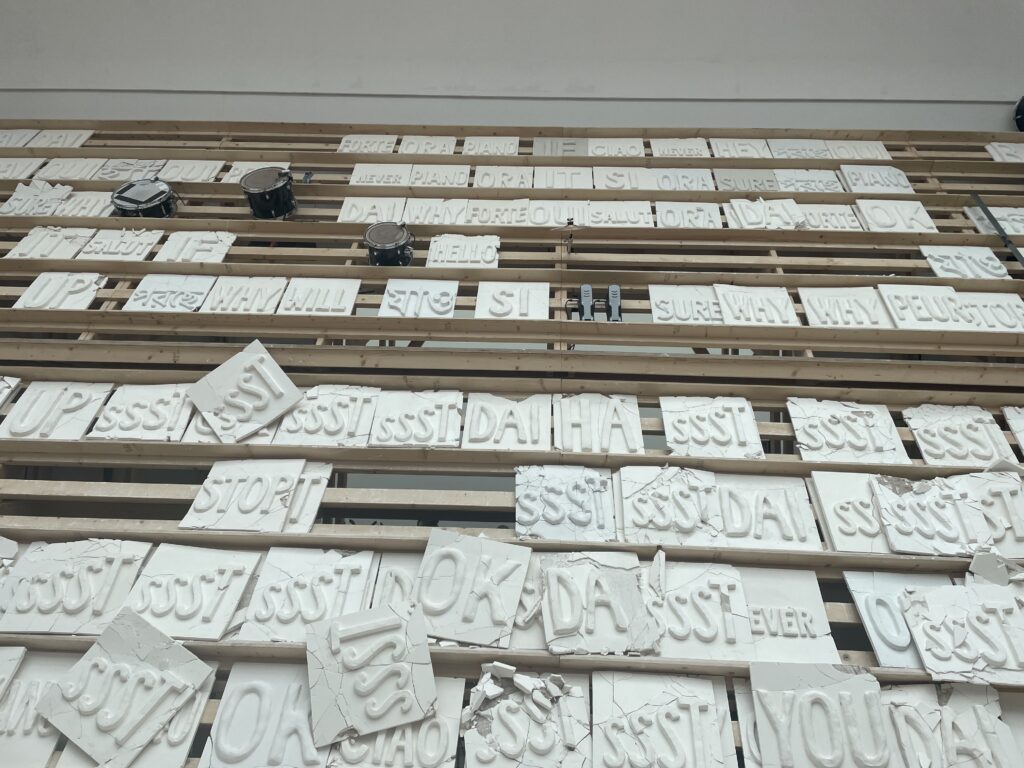
The Belgian Pavilion, transformed by Miet Warlop’s I Never PSSSST, becomes a charged performative field in which music, gesture and sculptural elements collide. Chalkboards and plaster-cast words occupy the rooms. The title ostensibly invokes silence, yet the work amplifies noise, failed transmission and the friction inherent in trying to connect within a disoriented world.
In the Finnish Pavilion, Jenna Sutela’s Aeolian Suite takes the winds of Venice as its protagonists. Hair-like sculptural forms respond to currents of air and sound, drawing on the theatrical and metamorphic register of commedia dell’arte. “My protagonists are the winds of Venice, which caress the lagoon city from all directions,” Sutela said at the opening.