L’AQUILA — L’Aquila is to become a vast collective artwork, as the city’s municipal council has approved a new edition of Inside Out, the global participatory art project by French artist JR, as part of the programme marking L’Aquila’s designation as Italy’s Capital of Culture 2026.
More than 2,000 residents of L’Aquila and the surrounding territory will be invited to sit for photographic portraits, which will be transformed into large-scale black-and-white posters and installed across the city’s urban spaces. The initiative, guided by ArtsFor, carries the motto “Siamo comunità” (we are community), a deliberate reference to the city’s ongoing reconstruction following the earthquake that devastated the Abruzzo capital in 2009.
Global movement
Inside Out was launched by JR in 2011 following his TED Prize and has since grown into an international movement with more than 2,600 collective actions in 152 countries and over 500,000 portraits gathered. The L’Aquila edition is the project’s largest in Italy to date. It forms part of the broader “L’Aquila città territorio” programme, developed under the ReStart development initiative, which positions culture as a tool for social cohesion, civic participation, and the promotion of inland communities.
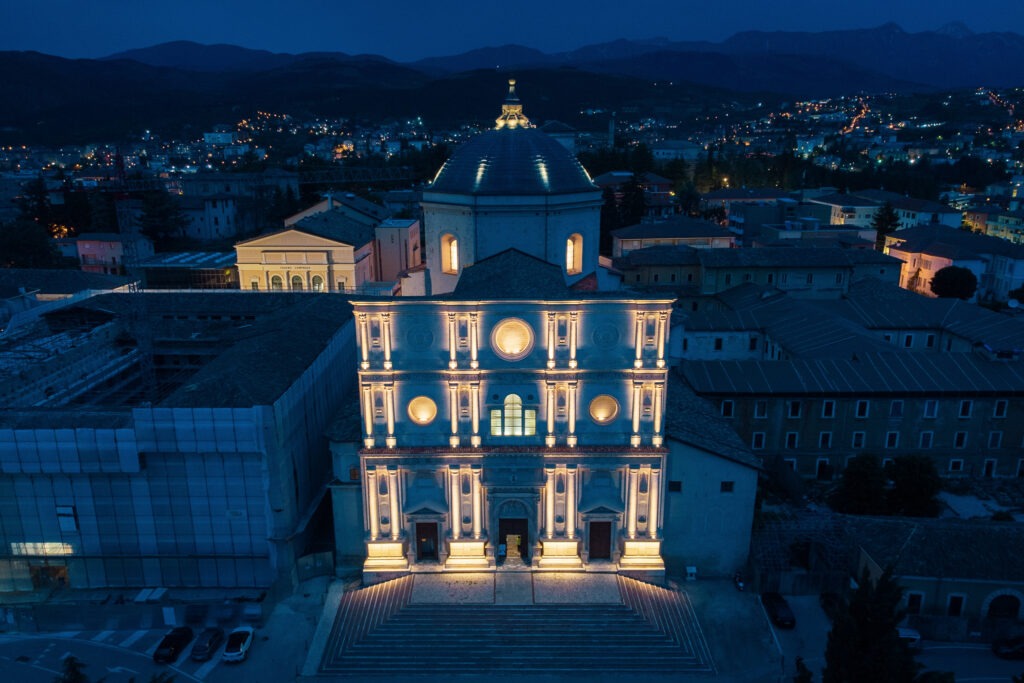
The project arrives at a moment of particular symbolic weight. The earthquake of April 6 2009 killed 309 people and displaced 70,000. Reconstruction stands at roughly 80 percent complete. Seventeen years on, L’Aquila’s selection as Capital of Culture 2026 frames that history not as a wound but as a source of civic identity and creative energy. The year features more than 300 events across 300 days, supported in part by the €15 million ReStart cultural initiative.
“Bringing JR’s project to L’Aquila means giving concrete form to one of the most important principles of our year as Capital of Culture: placing people and community at the centre,” said Mayor Pierluigi Biondi. “Through Inside Out, the faces of our citizens will become part of a great collective work capable of telling the identity of L’Aquila and the crater territory.” Biondi described the project as embodying the Capital’s working slogan, “Un territorio, mille capitali,” noting that L’Aquila represents a network of Apennine communities sharing history, memory, and a common future. “We want 2026 to be remembered not just as a great calendar of events, but as a moment of transformation,” he added.
The participatory actions will unfold through a series of community meetings and conversations ahead of the portrait sessions, ensuring the process itself becomes part of the artwork. For a city whose rebuilding has been as much psychological as architectural, the prospect of 2,000 faces covering its walls carries a weight that goes well beyond public art.