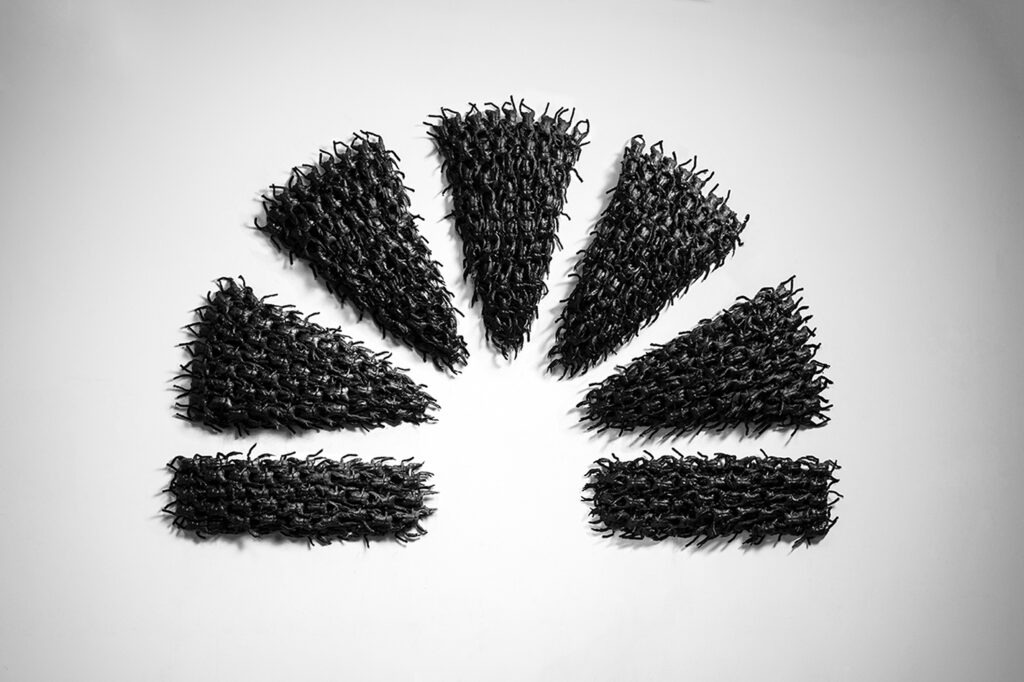
VENICE — Noemi Priolo’s ErbaLuce, visible in Venice until November 22, is an experience of passage bringing together organic, synthetic and transformed materials. At its heart is an imaginary plant inspired by the wild thistle of the arid Mediterranean. Another work, 965, builds dense, almost woven surfaces from countless minimal elements.
We asked Noemi about the plant, the materials and the idea behind the show.
Q. ErbaLuce is described as a space that makes stories possible. What did you want visitors to feel?
I wanted visitors to feel a sense of freedom and spontaneity, beyond judgement, to feel surrounded by a space where no rules are set in advance and anything is possible. We are used to imagining life as a predetermined straight line; I invite people to imagine a shape that is still open.
Q. Bubble Space is your private studio, which you open to the public as an art salon. Why did you choose this intimate setting?
Art needs time, and people need to pause. So I brought in a sofa and armchairs. Collaborating with Lineadombra, the restaurant downstairs, also made it possible to offer refreshments. I found myself having tea with my guests, surrounded by the works, and this completely changes how we experience art. You stay, talk, absorb the forms and ideas. Meanwhile, the light changes, and the magic remains.
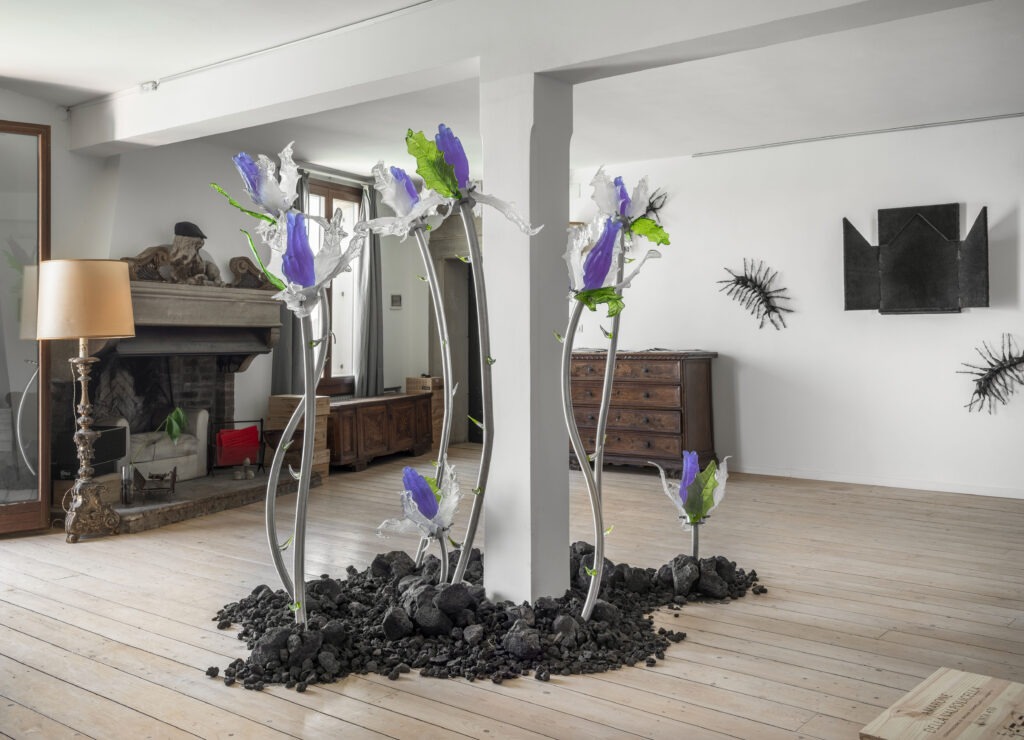
Q. The central work is an imaginary plant inspired by the wild thistle of the Mediterranean. What drew you to this plant?
I wanted peace, freedom and joy to spread like weeds. This is where the family of praying flowers, of which ErbaLuce is part, began: with a plant that would grow even where nobody wanted it. You pull it out, and it comes back. The wild thistle has that stubbornness, that almost insolent beauty. It does not ask permission. To me it also means home. I am Sicilian.
Q. You combine aluminium, glass and lava stone. How did you choose these materials?
The glass catches the light, echoing the dazzling sunlight of the landscapes I come from, while the lava stone absorbs it. Arid, dry, seemingly barren, yet capable of bringing forth life. These choices felt almost instinctive: I brought together my Sicilian roots and a fascination with Murano glass that has grown through my life in Venice.
Q. The glass flowers take the shape of hands joined in prayer. Why this gesture?
Joined hands evoke the state we seek in prayer or meditation: a peace where the boundaries of the body seem to dissolve and we feel part of the universe.These hands are tense because they are praying hard. Yet the gesture is also a gentle plea: “Please, take me towards the impossible.”
Q. 965 grows by accumulation, with minimal elements forming dense surfaces. How does this work speak to the rest of the exhibition?
965 is the other side, another story, equally true. It comes from a critical gaze that spares humanity nothing. ErbaLuce acknowledges that truth about ourselves yet glimpses the possibility of an alternative reality.
Q. Is there a message you hope visitors take away with them when they leave their visit?
More than a message, it is an invitation: don’t be a straight line. Open yourself to the possibilities of existence and surrender to the fleeting nature of life.