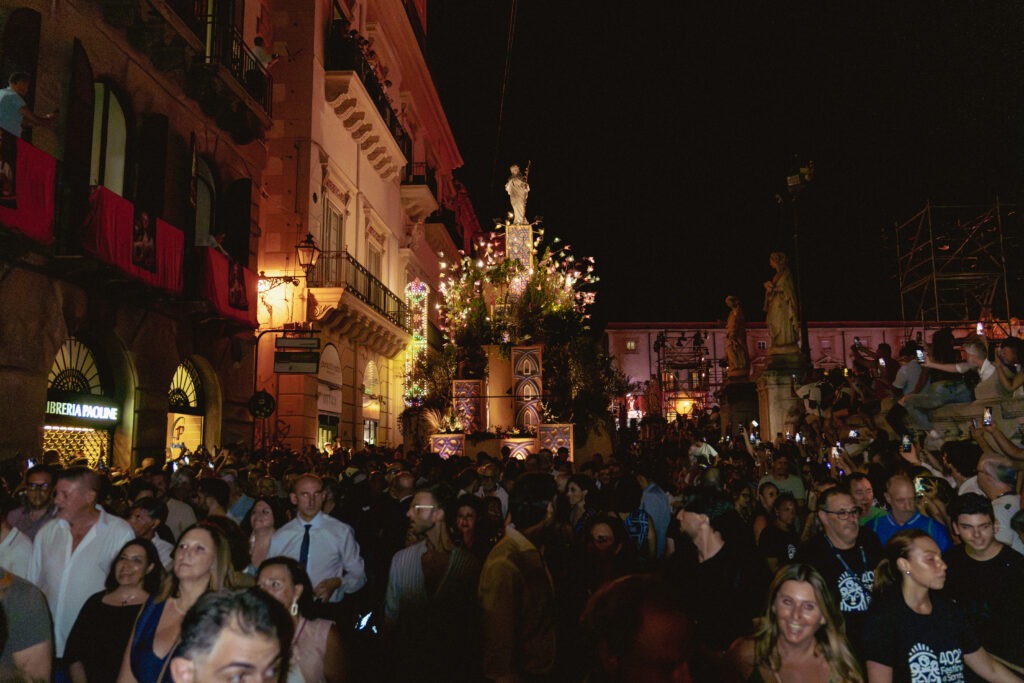
PALERMO, Sicily — A ship of roses and gilded cherubs is hauled down the central Palermo Cassaro area behind a team of oxen, and at the Quattro Canti road crossing the city shouts its saint’s name back at her. We spoke to Antonio Rini on the 402nd Festino di Santa Rosalia, which closed July 15 after six days. It was his first as Palermo’s culture assessore (councillor), a post he took in May after his predecessor Giampiero Cannella left for the culture ministry in Rome.
Rini is a Conservatorio Bellini flautist by training and a small-town mayor by apprenticeship, having run Ventimiglia di Sicilia before the city of Palermo called him in. He calls what he is hoping to achieve during his term in office cultural regeneration, and by this he means parishes, schools and peripheries as much as he means the lively historic centre of Palermo. He wants a culture office that people who have always found the Palazzo hard to walk into can actually walk into. Reopening the Biblioteca di Casa Professa is on his list. But the big night is the one that just passed, and next year it collides with the Norman millennium.
Q. What does this festival represent?
“It is the perfect synthesis of tradition and modernity, cut into the groove of our city’s sense of community. It is a hugely important event, tied not only to a spiritual moment but to a traditional one. And it is the highest and most noble moment in which the city connects with the soul of its saint. That is the most important thing about Palermo.”
Q. Why do the Normans come into it?
“It marks a thousand years since the birth of William the Conqueror, in 1027. The Norman influence here is not only symbolic, it is historical. And Rosalia herself was of Norman origin. So the festival will carry that double historical weight.”
Q. What does that layering say about the city?
“Cultures mixing with each other, contaminating each other, and the result is the identity of Palermo. It is the fruit of these dominations, these cultures laid one on top of the other, following one another over time. And today we are here.”
Q. Where does the festival actually go?
“There are stages, three ideal places in Palermo. Piazza dei Normanni and the Palazzo dei Normanni, the cathedral, then Quattro Canti and Porta Felice. Each of these moments marks an important aspect of Rosalia’s story.”
Q. Rosalia is known for ending the plague in 1624. What is the plague now?
“Every year we have some evil to free ourselves from. A few years ago it was Covid. Today, in Palermo, the new plagues could be the new drugs, crack for example. Each year has its own plague, updated to the signs of the times. Above all among the young and the very young.”
Q. Are there miracles?
“The miracle is exactly that deep connection you see every year in the faces and the eyes of the people of Palermo. Emotion, tears, moments of great joy, intense moments. All of it counts as a miracle, because it is the connection of citizens to their own city, of a people to its community.”
Q. And the visitors?
“Last year we registered 350,000, Palermitans and foreign visitors. This year, going by the hotel bookings alone, that will be comfortably beaten, past every kind of record.”