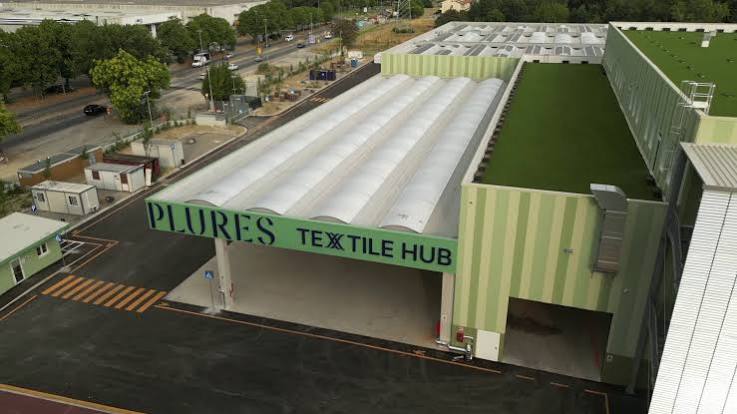

Prato has switched on what its developer calls one of Europe’s most advanced plants for recovering textile waste. The Textile Hub opened on July 22, 2026, on the site of a former municipal water treatment plant, built by the company Plures for 31.3 million euro, including 900,000 euro from PNRR, the European Union’s post-pandemic recovery fund for Italy, and an 850,000 euro tax credit under Industria 4.0, a national incentive for industrial technology upgrades. The plant answers European Union rules pushing member states toward a circular economy, an industrial model built on reusing and recycling materials instead of discarding them. Local media have described it as the largest facility of its kind in Italy.
AI sorts what hands cannot
The Hub can process up to 33,000 tonnes of textile waste a year, split between 20,000 tonnes of post-consumer clothing from across Tuscany and 13,000 tonnes of industrial offcuts. Of the post-consumer material, 60 percent goes toward reuse and 40 percent toward mechanical recycling, reaching end-of-waste status, the legal point at which recovered material stops being classified as waste and becomes usable raw material again. Optical sensors using near-infrared light, paired with artificial intelligence, read the fiber composition of each item and sort up to four tonnes an hour, far outpacing manual sorting.


“In just twenty-four months, an advanced technological plant was built that has found its natural home in Prato,” Mayor Matteo Biffoni said at the inauguration.
Plures president Lorenzo Perra described the Hub as a strategic investment in infrastructure and innovation, built ahead of EU deadlines to combine environmental sustainability with industrial competitiveness. Chief executive Alberto Irace said the plant answers rising demand for textile recovery while guaranteeing high-quality secondary raw materials.
From treatment plant to production site
The facility covers 7,000 square meters of covered space plus 10,000 square meters outdoors, and construction took 24 months. Full operational capacity is expected in 2027, when the Hub will employ around 50 workers across two shifts. Vice President Nicola Ciolini said the project pushes Prato’s manufacturing tradition toward digitalization, positioning the district’s textile regeneration for the future.
For Prato, long one of Europe’s textile manufacturing capitals, the Hub gives its industrial identity a new function, turning discarded fabric back into material the district can use rather than exporting the problem elsewhere.