

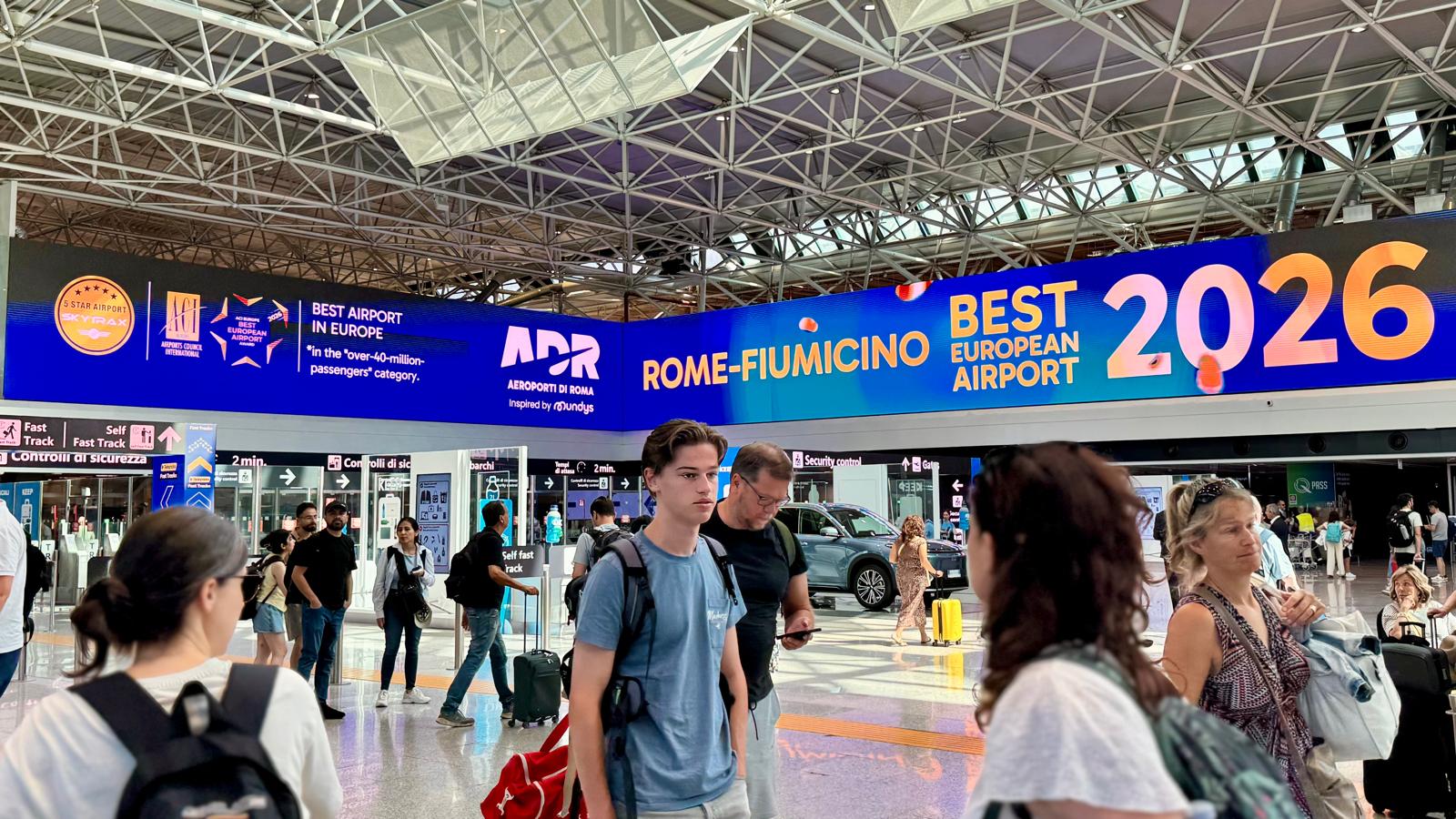

ROME — Fiumicino airport was named the best in Europe for the eighth time since 2018 on June 24, 2026, after an independent jury praised its staff, digital systems and environmental record at a ceremony in Prague. The award places the “Leonardo da Vinci” airport at the top of its category for the fifth year running.
“Once again confirming Rome Fiumicino at the top of European airports means giving continuity to an industrial model that combines service quality, operational efficiency, applied innovation and environmental sustainability,” said Marco Troncone, chief executive officer of Aeroporti di Roma, the company that runs the airport.
The prize was awarded by ACI EUROPE, a trade body representing airports across the continent. Judges included representatives from the European Commission and from EUROCONTROL, EASA and ECAC, the agencies responsible for coordinating flights, aviation safety and civil aviation policy across Europe.
A record year for passengers
The Prague award follows a separate honour in February, when Fiumicino was named Best European Airport in a ranking based purely on passenger feedback, run by ACI World’s Airport Service Quality programme. In 2025 the airport carried more than 51 million passengers for the first time, and it placed seventh worldwide in the Skytrax rankings, a British website that surveys airline and airport quality.

Fiumicino is increasingly attracting investors and companies seeking to leverage the large flow of tourists in transit through Rome or as Italy as their destination. Amongst these is top-end winemaker Ferrari which recently announced the opening of Ferrari Spazio Bollicine at the airport’s Terminal 3 on July 6.
Planning for 100 million passengers
Aeroporti di Roma, part of the Mundys Group, is now preparing a nine billion euro Sustainable Development Plan. The masterplan is designed to meet demand of up to 100 million passengers a year by 2046, nearly double current traffic. Troncone said the investment would strengthen Italy’s connectivity and support tourism and the economy, while capturing a greater share of long haul flights passing through Europe.
The scale of the plan reflects Rome’s ambition to compete with the continent’s largest hubs. For a city whose airport already anchors national tourism, the next test will be building the infrastructure fast enough to match the demand already arriving at its gates.