



ROME — A major exhibition connecting the ancient cities of Troy and Rome opened this week at the Colosseum Archaeological Park, running until October 2026.
“Troy and Rome. Myths, Legends, Stories of the Ancient Mediterranean” brings together archaeological finds, written sources, and artworks tracing links between Anatolia and the Italian peninsula back to 3,000 BC. The show follows a bilateral cultural cooperation agreement signed in April 2025 between Italy’s Minister of Culture Alessandro Giuli and Turkey’s Minister of Culture and Tourism Mehmet Nuri Ersoy, with a technical agreement finalized in December 2025.
Troy beyond Homer
“Troy is not only a myth, not only Homer, not only an intangible heritage of poetry. Troy existed,” said Alessio De Christoforo, one of the Italian curators, during the opening.
The exhibition’s first section, developed with Turkish archaeologists, surveys the civilizations of Anatolia during the Bronze and Iron Ages. An immersive film, partly created using artificial intelligence guided by archaeological data, recreates the ancient coastline near the Dardanelles and reconstructs the citadel of Troy as it may have appeared in antiquity.

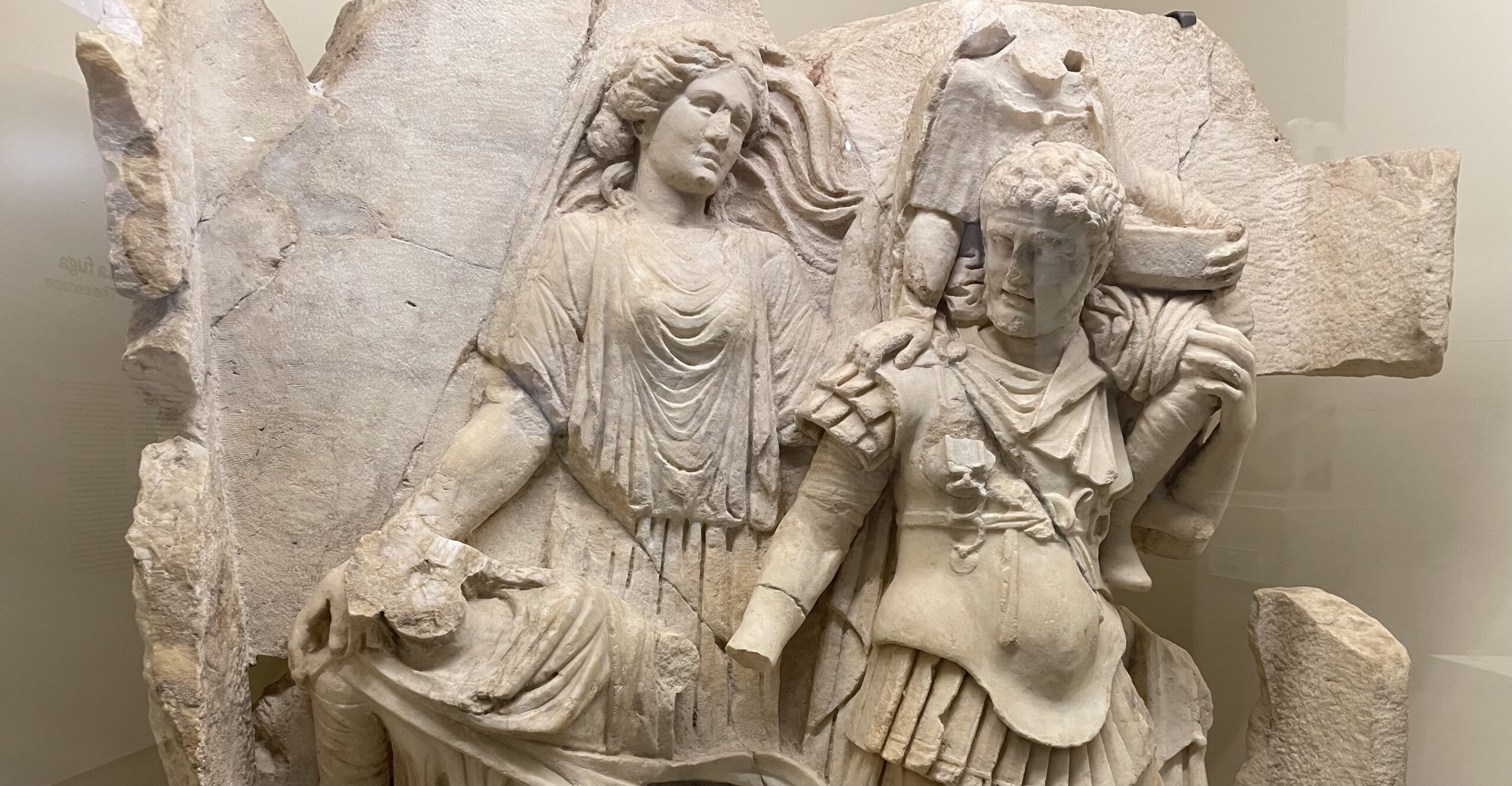
Among the highlights are 22 objects from 19 Turkish museums, displayed outside Turkey for the first time. One centrepiece is a clay tablet bearing an early written form of the name Troy, offering archaeological evidence that the city existed beyond Homer’s poetry. Visitors queue in front of the gorgeous marble sculptures recounting the history of Troy from the museum of Aphrodisias, alongside filigree and granulated goldwork dated between 2500 and 2250 BC, discovered at Troy by the German archaeologist Heinrich Schliemann.
“I have worked on Troy for 40 years, since I was a student,” said Rüstem Aslan, director of excavations at Troy. “This is the largest exhibition, with 300 exceptional objects, that I have realized in my career. You will never see a show like this again.”
The road to Rome
The second part of the exhibition follows the mythical journey of Aeneas from Troy to Lazio, where, according to tradition, he founded Lavinium, the city from which the royal line leading to Romulus and Remus descended.
“The exhibition deliberately keeps myth and archaeology as separate but equally valuable narratives,” De Christoforo said, “helping visitors understand how ancient peoples interpreted reality through storytelling rather than historical record.”



Come sempre la giornalista Benigna Mallebrei con la descrizione dei suoi articoli ti fa vivere belle sensazioni e l’immediata voglia di vedere al più presto ciò che racconta.