SAN GIMIGNANO — Local authorities in San Gimignano February 27 unveiled the completed conversion of the medieval convent of San Domenico, which served as a working prison for well over a century, into a public cultural space.
“We are not just recovering a building,” said Mayor Andrea Marrucci. “We are giving the city back a fundamental part of its soul.”
San Domenico sits minutes from the Piazza della Cisterna and San Gimignano’s famous medieval skyline. For most visitors the town presents itself as a seamless postcard: cobbled lanes, stone facades, towers unchanged since the 13th century. Yet behind that surface lies a considerably more layered history.
The convent was founded by Dominican friars in the 13th century before a carcere took root within its walls, persisting for well over a hundred years and inscribing its logic deep into the architecture: barred windows, narrow corridors, isolation cells, and walls deliberately thickened to suppress sound.
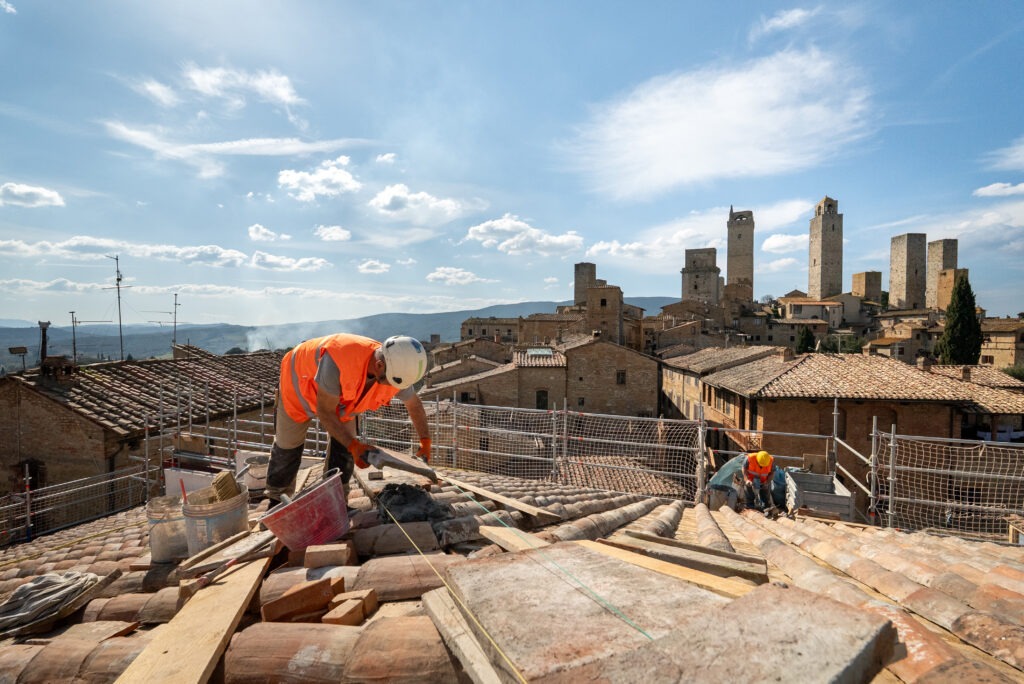
Slow architecture, deep memory
The ExCelle project, backed by the Tuscany Region, the Municipality of San Gimignano, and Opera Laboratori turn the complex into a multi-use cultural hub which will be part exhibition space, part archaeological laboratory, and part conservation workshop.
“Every gesture we are making is forging new spaces,” Opera Laboratori president Beppe Costa told Italy Now. “From silence, a museum of visions will be born. And where there was closure, culture will dwell.”
Opera Laboratori already manages the town’s Duomo and Civic Museums
Architects describe their approach as slow architecture — incremental, reversible interventions guided by minimal but meaningful change. Fragments of frescoes have already emerged from beneath later coatings. Prison records, buttons, coins, and scraps of clothing left by inmates will be woven into the exhibition, not as macabre curiosities but as evidence of the social forces that shaped the town across five centuries.
Funding commitments and timelines were confirmed, positioning Ex Celle as a headline project for Tuscany’s 2026 cultural calendar. Marrucci described the closure as a wound in the town’s civic fabric, and the reopening as significant not only for San Gimignano but for the entire Val d’Elsa. When Ex Celle opens, the town’s symbolic geography will shift — from vertical monuments celebrated for their beauty to a more interior history that asks visitors to look at what was deliberately hidden, and to sit with what they find there.