VENICE — The 2025 Venice Biennale opened this week under exceptional circumstances, with its international jury resigned, Russia’s participation contested by the Ministry of Culture, and protests marking the pre-opening days. The event runs until November 22.
Security was visible throughout the opening, especially outside the Russian pavilion, but also near the US and Israeli pavilions. Pre-openings were marked by peaceful protests from artists and activists drawing attention to the war in Gaza, and some visitors encountered closed pavilions along the way.
With 99 countries presenting across the Giardini, the Arsenale and palazzi throughout the city, the Biennale once again offers a dense journey through national positions, visual languages and political atmospheres.
Pavilions that speak loudest
The theme, In Minor Keys, presented by curator Koyo Kouoh and the curatorial team, brings together artists whose work explores history, memory, identity and form. The following pavilions stand out for both their ideas and their immediate visual force.
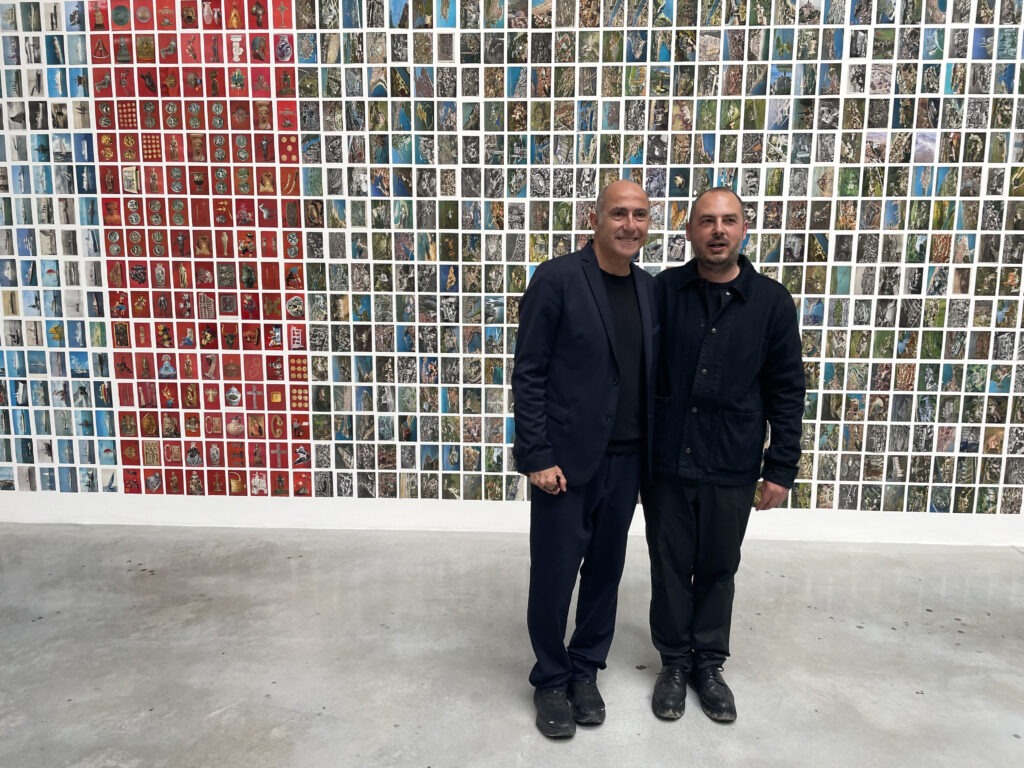
The Spanish Pavilion is one of the most striking. Oriol Vilanova, born in 1980 in Manresa, Catalonia has used 50,000 postcards to cover the space. “I bought them at the Sunday flea market, and I also create smaller-scale artworks,” he says. “I’ve been collecting for 20 years and it’s become a ritual.” He prefers the market to the museum. “We are in the Spanish pavilion but surrounded by the whole world,” explains curator Charles Guerra, who has known the artist for two decades.
Clay, postcards, and flowers
The Russian Pavilion, by contrast, attempts to redefine the country’s cultural presence through the work of 50 international musicians, poets and philosophers. The installation moves from the guttural singing of a trio dressed in black Kutten (hooded robes) to a techno DJ surrounded by an enormous mass of flowers, insisting that culture can outlast politics.
The Italian Pavilion, featuring Chiara Camoni’s Con te con tutto, finds its minor key in clay and in the traditions of the so-called minor arts, especially Etruscan art. Visitors are welcomed by life-sized clay figures gathered like a forest. In the next room, languages, figures and chronologies enter into dialogue around an installation resembling a terracotta artist’s studio activated as a live performance. “I want to celebrate the beauty of reuse and social interaction,” Camoni said.