PONTEDERA, Tuscany — Vespa is marking eighty years since Piaggio, the Italian manufacturer, registered its original patent on April 23, 1946. Since then, almost 20 million Vespa scooters have been built and ridden across five continents, making it one of the first truly global mobility brands.
“To me, a Vespa means three things,” said Carmine Soprano, an economist. “It’s a lifestyle, it’s a family tradition, and it’s a national icon.”
The brand’s growth has accelerated sharply this century. Annual production rose from 58,000 units in 2004 to more than 100,000 in 2006, then 180,000 by 2017, passing 200,000 units a year in 2018. More than 2 million new Vespas have been produced in the past decade alone.
Three factories, one design
Vespa is now built at three sites. Production has continued without interruption since 1946 at Pontedera, in Tuscany, supplying Europe and the Americas. A plant in Vinh Phuc, Vietnam, serves the Far East, while a factory in Baramati, India, opened in 2012 to supply the Indian market.
Each Vespa is built around a load bearing steel frame, a structural design in which the body itself supports the vehicle’s weight rather than relying on a separate chassis. The approach has remained largely unchanged since the scooter’s launch, even as engines and technology have modernised.
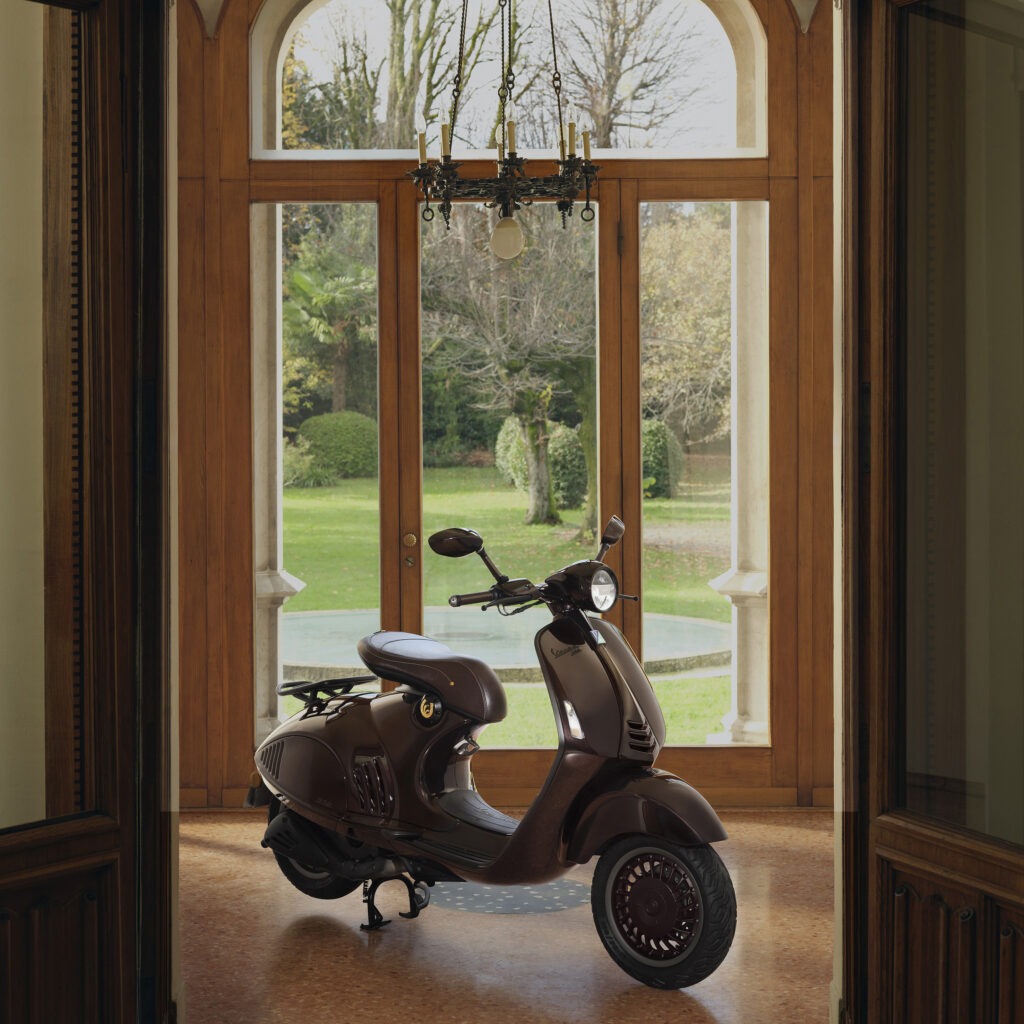
Year of the Horse
The current range spans several models. The Primavera and Sprint target younger riders and have inspired collaborations with designers including Sean Wotherspoon and Justin Bieber, and with brands such as Disney. The GTS range offers the most powerful engines Vespa has built, including ABS braking, a system that prevents wheels locking during hard braking, and traction control for safer acceleration.
In 2026, Piaggio will launch the Vespa 946 Horse, a limited edition marking the Year of the Horse in the Chinese zodiac calendar. Finished in a bay colour reminiscent of a horse’s coat, the model features a leather saddle inspired by equestrian tack and handcrafted trims, continuing a production process closer to an atelier than a factory line.
Family inheritance
For many owners the appeal has little to do with speed or convenience. Owning a Vespa is not about getting from one place to another but about enjoying the ride, a different philosophy of moving on two wheels, Soprano said, adding that his own Vespa had belonged to his father.
“Many of my friends own Vespas that had been in the family for decades, so it really is a way to reconnect with your own family ancestry,” Soprano told Italy Now. “And ultimately, a Vespa is also the ultimate Italian icon.”
Cinematic memory
That inheritance is also a cinematic one. “For me it symbolises the Italy of the postwar years and of auteur cinema,” said Giuseppe Bellavia, vice president of an investment company. “When you could still cross Piazza di Spagna on a Vespa, you felt as though you had been projected onto a strip of film.”
Piazza di Spagna is the Roman square at the foot of the Spanish Steps. Eighty years after the patent, the Vespa carries as much of that memory as it does traffic.