

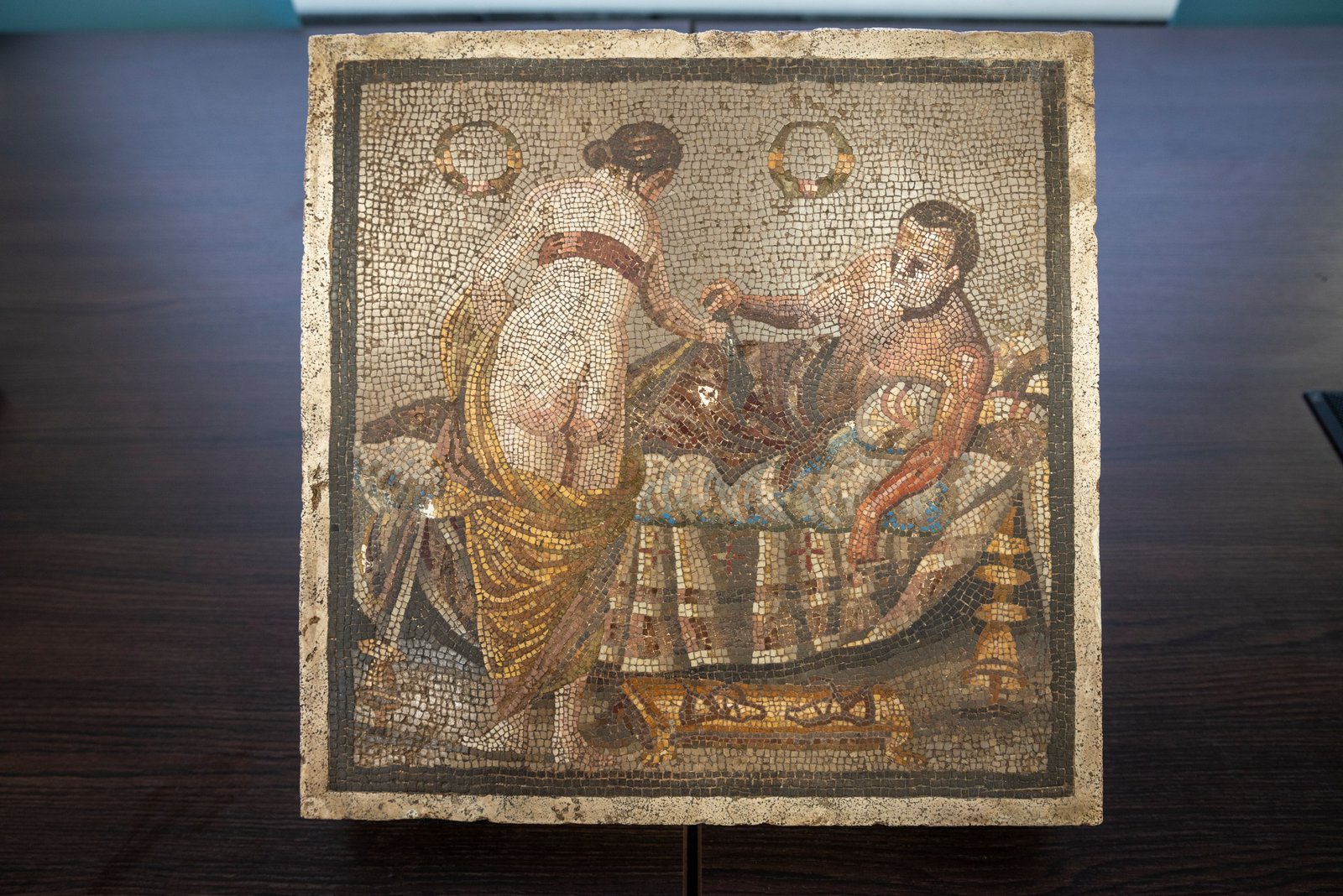

POMPEII — A Roman mosaic depicting an erotic farewell scene, looted by a Wehrmacht officer during the Second World War and returned to Italy in 2025, has been traced to its original location in the Marche region following newly published archaeological research. The discovery closes a cold case spanning nearly two millennia of history and eight decades of displacement.
The mosaic was handed over in July 2025 to the Pompeii Archaeological Park after the heirs of a German citizen chose to return it to the Italian state. The captain who took it was part of a systematised wartime plunder: between 1943 and 1945, Nazi forces looted thousands of Italian artefacts, many recovered only now. With no clear record of its origin, the Ministry of Culture initially assigned the work to Pompeii, where similar pieces had been found near Vesuvius.
A notebook from 1868 holds the answer
A research project launched by the Archaeological Park in collaboration with Sannio University overturned that assumption. Archaeometric analyses showed the mosaic was most likely produced in workshops in Lazio and distributed commercially across Roman Italy, reaching Campania, Puglia, and the Marche. The decisive breakthrough came through a chance encounter in 2025 with archaeologist Giulia D’Angelo, originally from the Marche and co-author of a study published in the Pompeii excavations’ e-journal.
Her research led scholars to a notebook dating from around 1868, written by painter and archaeologist Giulio Gabrielli and preserved in the municipal library of Ascoli Piceno. The manuscript contains a sketch of the mosaic and a title Gabrielli gave the scene: “The Farewell of a Hetaera.” The image shows a man offering a purse of coins to a partially undressed woman in a gesture at once intimate and ambiguous — an evocation of the hetaerae (educated courtesans of the ancient world, often muses to poets and philosophers), whose influence extended well beyond the transactional. Gabrielli’s notes record that the mosaic had been discovered on land owned by the Malaspina family in Rocca di Morro, a hamlet in the municipality of Folignano, Marche.
“Protecting cultural heritage continues through rigorous study, scientific verification and the restoration of historical truth,” Culture Minister Alessandro Giuli said. Local authorities in Folignano have welcomed the findings and are exploring future exhibitions to highlight the site’s archaeological significance. For the Marche, a region whose Roman past remains largely uncharted, the mosaic’s return is less an ending than an opening.