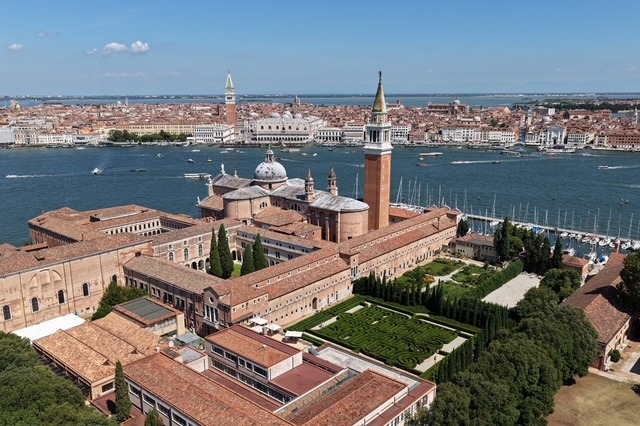
VENICE — Venice’s Fondazione Giorgio Cini has completed restoration of the Borges Labyrinth, the boxwood maze on the Isola di San Giorgio Maggiore, ahead of the fortieth anniversary of Jorge Luis Borges’s death and fifteen years after the labyrinth’s creation. PwC Italia funded the project as main sponsor.
Renata Codello, secretary general of the Giorgio Cini Foundation, said restoration work has shaped the foundation’s mission on the island since 1951. “This intervention at the Labyrinth demonstrates how it is possible to restore a living architecture that is volume, geometry, meditative space and a page of literature,” she said.
Giovanni Andrea Toselli, chairman and chief executive of PwC Italia, the Italian arm of the global professional services network, said the project combines heritage protection with accessibility. “Supporting this project with the Fondazione Giorgio Cini means making a site of great artistic and symbolic value more accessible to different audiences,” he said.
The labyrinth honors Jorge Luis Borges, the Argentine writer known for stories built around mazes, mirrors and infinite libraries, who died in 1986. It stands beside two cloisters by architects Andrea Buora and Andrea Palladio, forming a third cloister. Opened in 2021 through tours run by VisitCini, it has drawn more than twenty five thousand visitors in five years.
Replanting a living maze
Workers removed 165 dead or weakened boxwood plants, a slow growing hedge shrub known as Buxus sempervirens, and overhauled the irrigation system. Crews added new soil and fertiliser, then planted mature replacement boxwood pruned to match the maze’s existing shape. Thirty further plants were added later where growth had failed, alongside manual weeding throughout the site.
Widening access
The restoration targeted accessibility. Workers leveled the entrance path, cleared excess gravel and installed honeycomb panels for visitors with reduced mobility. With the Venice branch of the Unione Italiana dei Ciechi e degli Ipovedenti, the national association for blind and partially sighted people, the foundation added a tactile map explaining the maze’s layout before visitors enter.
“The theme of accessibility to places of culture is much broader than commonly imagined,” Codello said. “Offering a positive experience that can be shared with others is an important matter of inclusion.”
The Borges Labyrinth reopens to visitors from mid July 2026, with updated opening hours listed on VisitCini’s website. In autumn, PwC Italia will open the maze free to the public for one weekend, with booking details to follow through the foundation’s official channels.