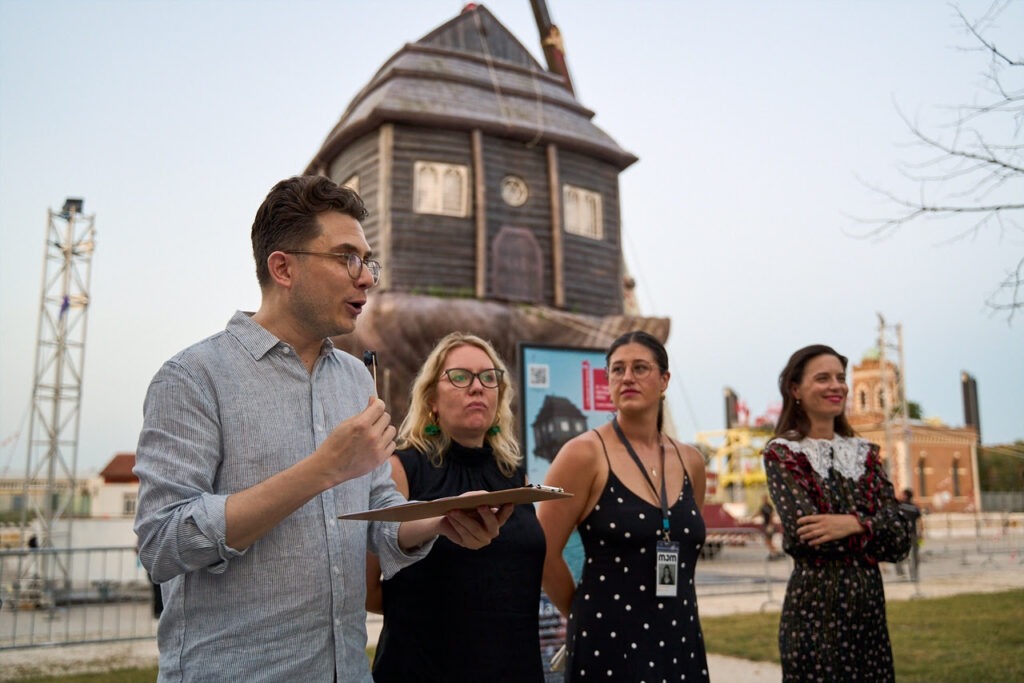
VENICE — A synagogue started hovering above the Venetian lagoon this week following the opening of Nabatele as an official collateral event of the 61st International Art Exhibition of La Biennale di Venezia. The work stays until September 16.
“Nabatele explores the tension between gravity and buoyancy, the gentle effort of existing uprooted,” said Anna Kamyshan, the London based architect and artist who made the work. “The constant light from the synagogue windows symbolizes for me that inner flame that is not extinguished by any turbulence.”
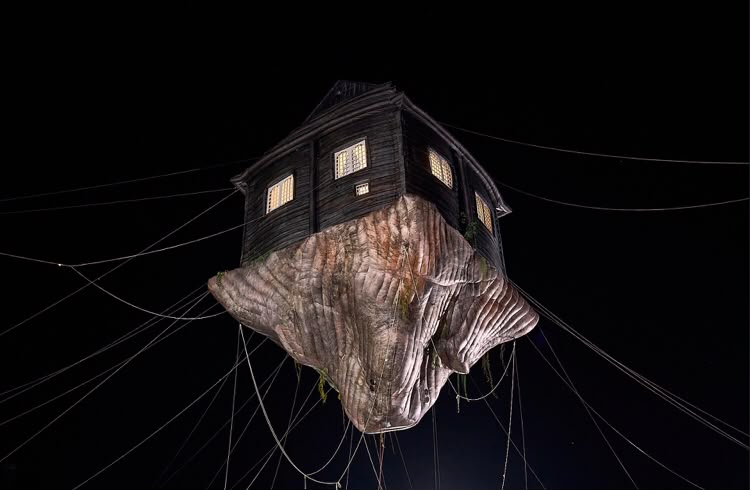
Nabatele is a helium filled aerostat, a balloon of double membrane construction, that rises as high as 25 metres above the water. The upper section takes the form of a wooden synagogue of the kind once built in the shtetl, a small Jewish market town of eastern Europe. Beneath it hangs a rock carrying roots and fragments of stone.
“Nabat, a Slavic word that entered Yiddish in the early twentieth century, means an alarm, a warning bell, or a call to vigilance,” said art historian Kostantin Akinsha. “According to the project’s description, ‘the Yiddish diminutive -ele softens nabat, transforming a warning into a quiet, gentle presence rather than an urgent alarm.’
“To me, however, the title is best understood as a tender signal of remembrance,” he added.
The windows stay lit day and night, a reference to the Ner Tamid, the eternal lamp that burns in every synagogue.
The title joins nabat, a word carrying Slavic and Semitic senses of warning and alarm, to the Yiddish diminutive ele, which shifts it towards something quieter and more intimate.
Kamyshan was born in Lviv, Ukraine, and is of Jewish and Russian heritage. She helped shape the vision for the Babyn Yar Holocaust Memorial Center in Kyiv.
The curators place the piece inside Yiddishland, a pavilion that belongs to no state.
“The Yiddishland Pavilion is a conceptual pavilion, not a national one, belonging to an imaginary country shaped by Yiddish language and culture,” said curator Maria Veits.
“It is a non territorial cultural continuum, preserved through language and memory rather than land or sovereignty,” said Maria Veits.
Ghetto reversed
Venice enclosed its Jewish population in the first ghetto in 1516, and the synagogues built there in the 16th century sat on the upper floors of ordinary buildings, unannounced from the street. Kamyshan takes that elevation and reverses its purpose. Her temple is high up and impossible to miss.
The Montreal Jewish Museum organised the project and intends to host it in North America once Venice closes.
“We understand the project as a point of connection over the long term,” said Alyssa Stokvis-Hauer, artistic director of the Montreal Jewish Museum.
Berlin, Warsaw, New York, and London are named in project documents as future stops. For two months, though, the question sits over the lagoon, lit from within, going nowhere and anchored to nothing.