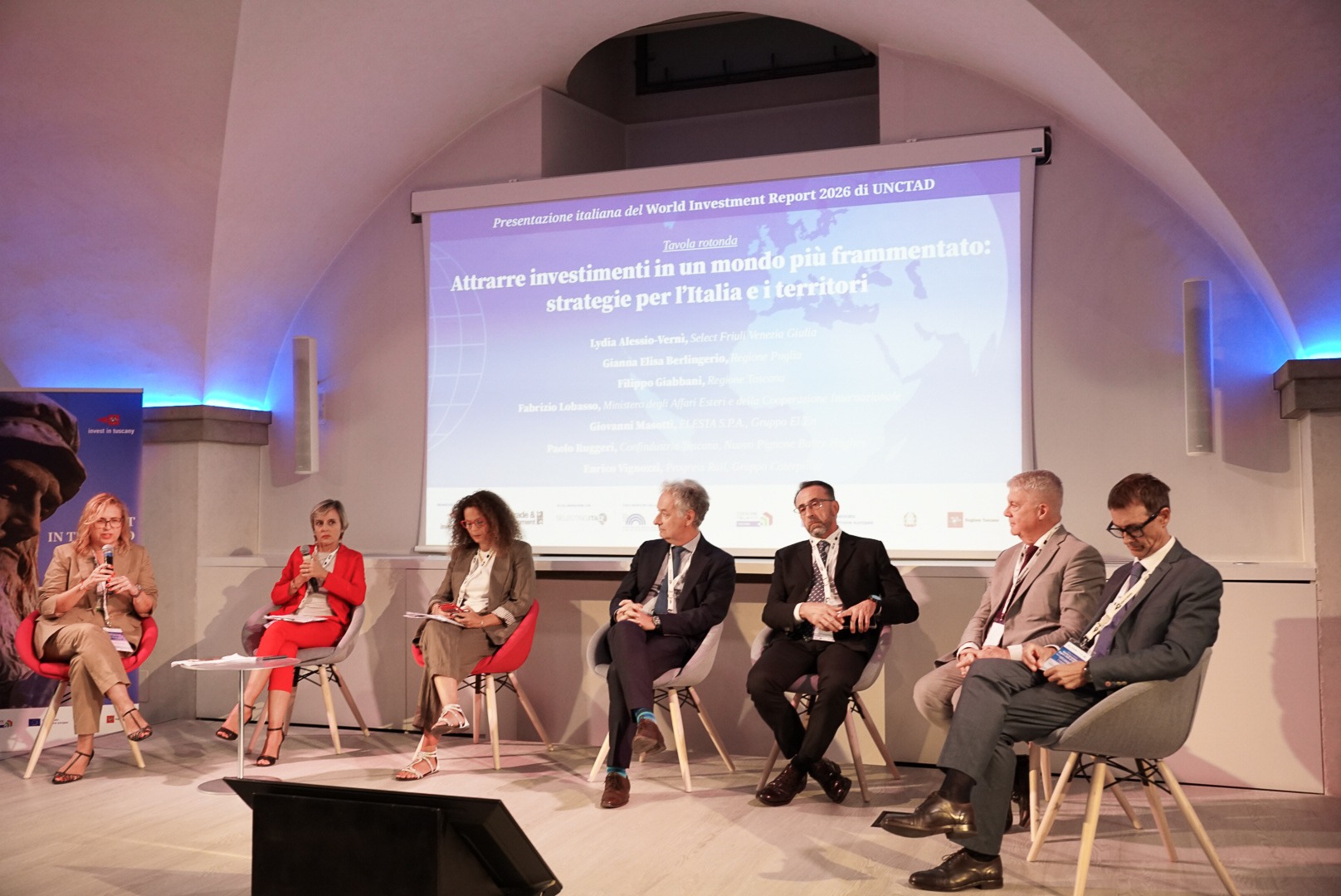

FLORENCE — Tuscany’s regional government hosted the only Italian presentation of the World Investment Report 2026 in Florence earlier this month, and used the stage to illustrate the region’s attractiveness to foreign investors.
The annual report comes from UNCTAD (UN Trade and Development, the Geneva body that tracks global investment). The Florence session was billed as the official run-up to Selecting Italy, a national forum on foreign capital run by the Conference of Regions and Autonomous Provinces, which groups Italy’s regional presidents.
“It is a source of pride for Tuscany to host the only Italian stop of the World Investment Report 2026 presentation,” said Eugenio Giani, President of Tuscany. “UNCTAD’s choice confirms the great work done in recent years to build an ecosystem capable of attracting, supporting, and growing quality investment.”

Capital’s new map
Presenting the findings, Bruno Casella, a senior economist at UNCTAD, said artificial intelligence and data center infrastructure alone now accounts for roughly a third of global foreign investment, Invest in Tuscany reported. Conventional car making, electronics, and textiles are under pressure.
Worldwide, foreign direct investment rose six percent to 1.6 trillion dollars in 2025, ending two years of decline, the report found. For Italy, speakers in Florence named semiconductors, data centers, and renewables as the main drivers.
Between 2019 and 2025, Tuscany recorded 303 foreign investment operations, 202 of them greenfield projects built from scratch and 101 mergers or acquisitions, worth more than 12 billion euros and creating over 15,000 jobs, intoscana, the region’s official portal, reported from Invest in Tuscany’s March annual meeting. Around 1,400 foreign controlled companies employ more than 90,000 people in the region.


Keeping investors
Filippo Giabbani of Invest in Tuscany, the regional office that courts foreign companies, argued that with protectionism rising abroad, the urgent task is caring for firms already there, not only chasing newcomers.
Valentino Valentini, Italy’s deputy minister for enterprises and Made in Italy, said investors watch how fast a territory responds and whether national, regional, and local government pull together.
The talent gap
One constraint identified by analysts was people. A report drawn up by TEHA Group presented in March found nearly half of Tuscan hires hard to fill, and the region has expanded ITS Academy technical courses – which aim to make apprenticeship and practical learning available – from 24 in 2020 to 67 today.
Tuscany’s pitch rests on industrial districts, universities, and patient aftercare. Training enough technicians to keep the investors it already has may matter more than winning the next one.