
ROME — Inside Villa Sordi, the Roman home turned museum where Alberto Sordi lived with his two sisters until his death in 2003, Alessandra Maria Sette, curator of the villa’s exhibitions, explains why Italy’s most beloved actor was far more complex than his comic persona suggested. A new wave of tributes marks the 10th Alberto Sordi Family Award, held April 16 at Rome’s Casa del Cinema, honouring his enduring legacy across cinema, culture, and public life. Sordi, she says, invented the commedia all’italiana (Italian comedy genre) almost single-handedly, anticipated social revolutions through his films, secretly donated billions of lire to Rome’s hospitals, and would have been an antique dealer had he never become an actor.
Q. For someone not born in Italy, how would you describe Alberto Sordi?
A: “Alberto Sordi is without doubt the most well-known and most representative actor in Italian cinema. He was born in 1920 and very quickly became one of the most appreciated, most admired actors in the whole of Italian cinema. He invented a genre, the commedia all’italiana, which went on to achieve enormous success.”
Q. But he was more than a comic actor?
A: “Sordi was much more than this, because Sordi was a true intellectual who always loved cinema. His entire life was dedicated to it. He not only acted. Very often he wrote for cinema, contributed to screenplays, invented new genres, and with his films he even anticipated certain small social revolutions that were about to happen. Sordi’s life is closely tied to the history of Italy, because he interpreted Italian society itself.”
Q: What did this villa represent for him?
A: “His villa was a very important place, because Sordi lived here with his sisters. They were four children. Sordi and his two sisters never married. He took care of them. He bought this villa, restored it, and came to live here with them. It became the place where he could withdraw a little from the extremely demanding world of cinema. When he came home, he was looking for an oasis of calm, and this was that oasis.”
Q. He was famously quoted as saying he would never marry. What was behind that?
A: “He said he didn’t want to bring strangers into the house. But in reality this was a remark for journalists, for the press. The truth is that Sordi never wanted the commitment of a family, because he wanted only to do cinema. With an admirable intellectual honesty, he dedicated himself solely to cinema. He more than once said he wanted to be free to dedicate himself to cinema.”
Q. He had a reputation for being careful with money, yet he gave secretly to hospitals. How do you reconcile that?
A: “He was considered this way, but in reality it was not so. Sordi was a child of his time. He was born in 1920, he lived through the end of one war and through another war, years in which there was no food, in which there was absolute poverty. So his upbringing was one of not wasting, of concentrating on what was necessary, and this formation he kept his whole life. He was extremely generous, he gave a great deal to charity in secret, he did not publicise it, and he did a great deal of good for many institutions.”
Q. Is there one film that is emblematic of his work?
A: “I cannot name just one film, because Sordi interpreted Italian society, which in those years was in continuous and rapid evolution. But I can name a film that is a great personal passion of mine, Una vita difficile, where Sordi plays a dramatic role. He is better known for his comic parts, but in reality he was a great dramatic actor. In this film he is extraordinary. He plays a partisan who, once the war is over, struggles to find his place in society.”
Q, He was also a passionate collector of antiques and art. What does the villa reveal about that side of him?
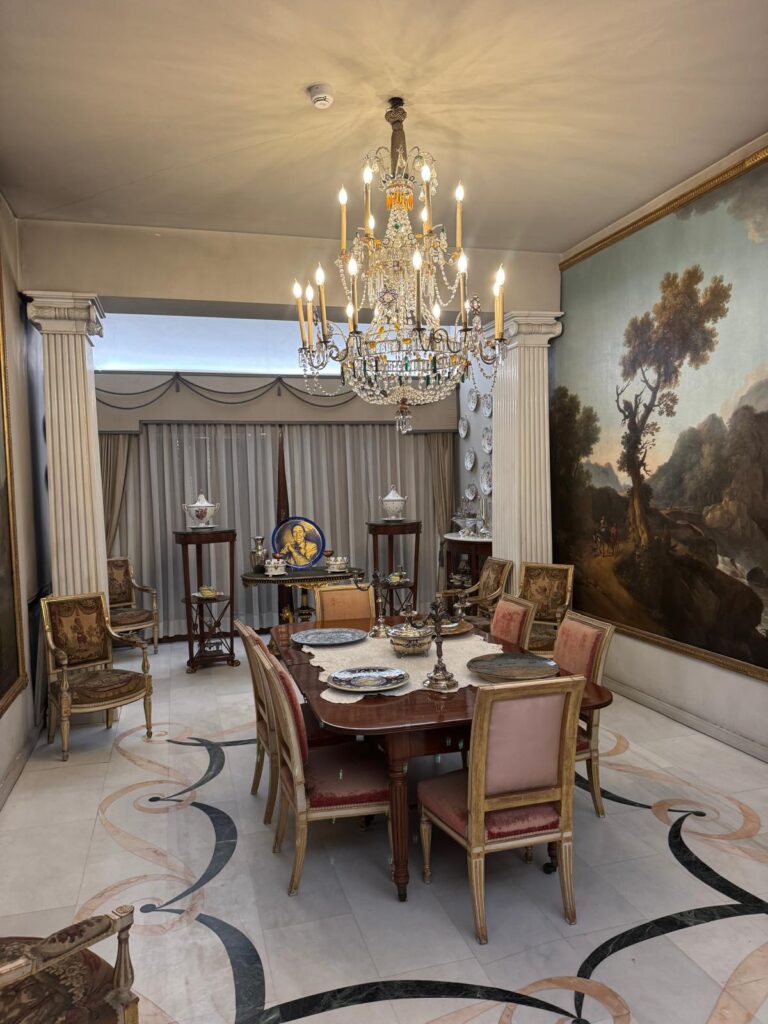
A: “Sordi was passionate about antiques and more than once declared that if he had not become an actor he would have become an antique dealer. He even directed a film on this, Fumo di Londra, in which he plays a Roman antique dealer who goes to London. In the dining room on the upper floor, he bought 18th-century paintings that cover all four walls, and that is where I find his taste most clearly. He also came to know the painter Giorgio De Chirico and bought two paintings from him, so at that moment he moved into the contemporary as well. He was a very curious man.”
Additional reporting by Sabina Castelfranco