SCORRANO, Abruzzo — Scorrano, a hamlet of 50 people in Cellino Attanasio, Abruzzo, is staging its sixth Borgo da Favola (Fairytale Village) festival on April 25, filling medieval lanes with muralists, storytellers, and live theatre in a deliberate bid to slow the emptying of rural Italy.
“When you visit the village, you truly feel that time has stopped,” said Elisabetta, a visitor from San Benedetto del Tronto. “The colours of the drawings on the walls accompany you like a fairytale. It is a place that transmits a deep, quiet peace.”
The village is located a stone’s throw from Italy’s Adriatic coast, in the central Abruzzo region and some30 km from the town of Teramo.
The festival, launched in 2019 by the local council, has turned Scorrano’s historic centre into a permanent open-air gallery. Walls carry murals of La Bella Addormentata (Sleeping Beauty), Il Piccolo Principe (The Little Prince), Alice in Wonderland, Little Red Riding Hood, and Moby Dick. QR codes beside each work let visitors stream the corresponding story on their smartphones. A printed map guides visitors and art afficionados through the full circuit.
“The project was born with the aim of giving new life and prospects to this small town, hit hard in recent years by depopulation,” said Luisana Ferretti, deputy mayor of Cellino Attanasio. “The results are becoming tangible. Visitor numbers are growing on weekends, and some families have already chosen to buy homes and settle here permanently.”
The initiative sits within a broader national conversation about the survival of Italy’s smallest settlements. Thousands of borghi (villages) across the country have lost more than half their populations over the past 50 years, as younger generations migrate to cities. Scorrano’s response has been to attract visitors first and residents later.
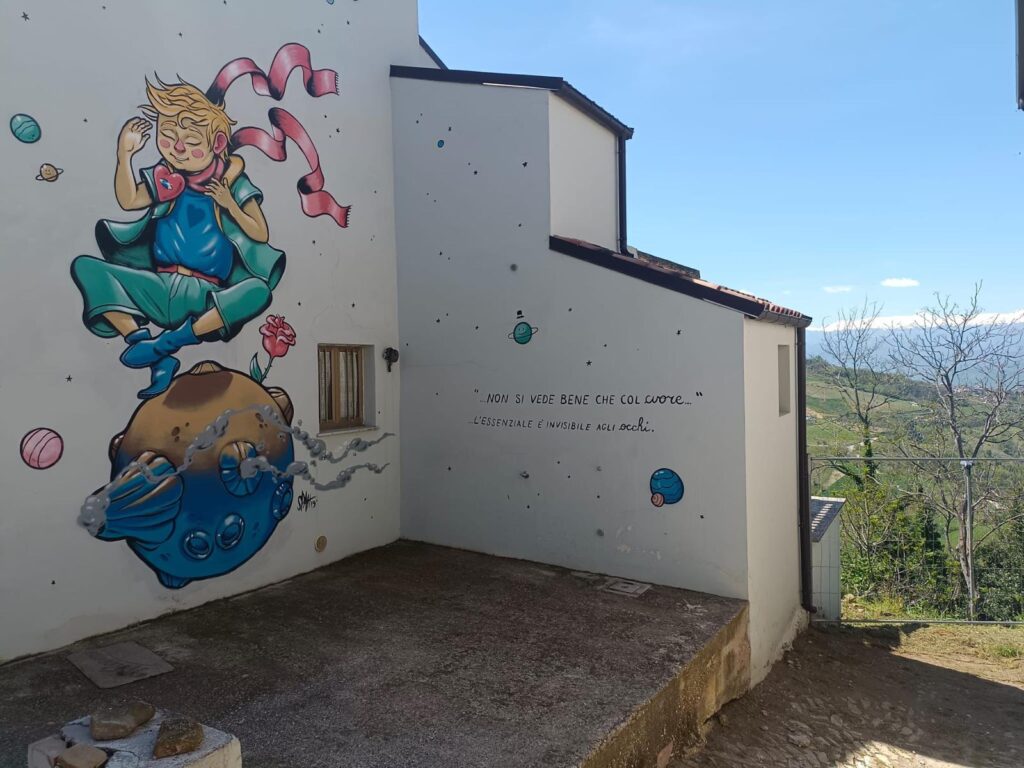
Painted murals (Credits: Archeoclub Italia)
Rationale
“It is a question of bringing children back to the territory, and with children come families,” Ferretti said. “The project transforms the village into an open-air museum, combining art, identity, and territorial regeneration in a centre that was almost completely abandoned.”
The sixth edition adds a large mosaic to the five previous editions of murals, alongside children’s theatre performances, guided tours, food and wine experiences, and an evening concert.
Martina Pantaleo of Archeoclub d’Italia in Cellino Attanasio, who helped design the project, said the QR code system was also a model for how technology could serve cultural heritage rather than compete with it.
The festival also celebrates the stories of Gianni Rodari, Italy’s most beloved children’s author, with readings and performances woven through the day’s programme.
Cellino Attanasio itself adds historical depth to the visit. The town’s medieval fortifications recall a 1462 siege that reshaped the region’s balance between Angevin and Aragonese forces. The nearby Torre di Montegualtieri offers views stretching from the Adriatic coast to the Gran Sasso massif.