

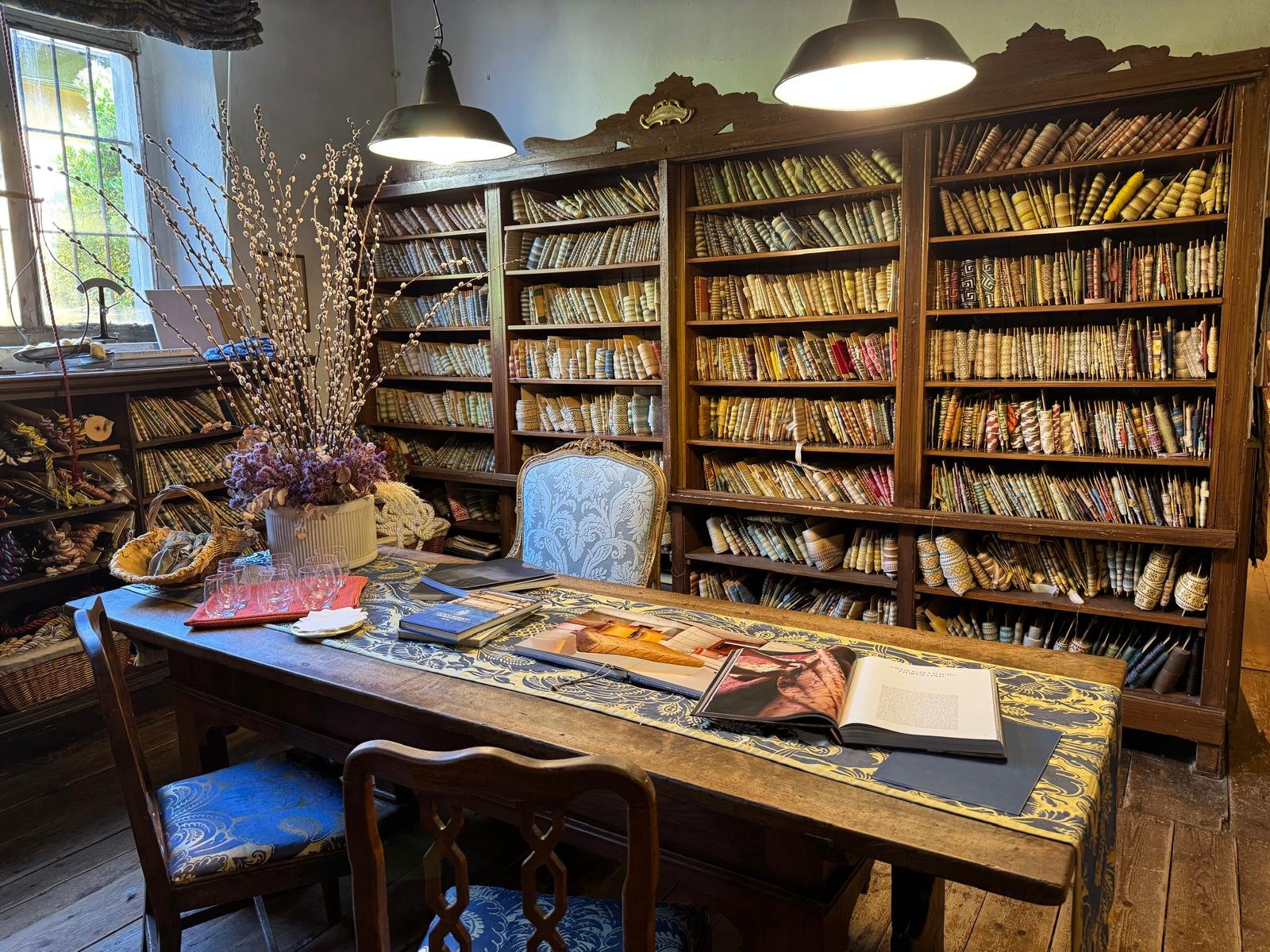

FLORENCE — In November 2025, a new fabric design emerged from the historic archive of the Antico Setificio Fiorentino in Florence’s ancient San Frediano quarter. The broccatella Folia, a pattern whose origins lie centuries deep in Florentine textile tradition, was announced to the world via social media, accompanied by a simple declaration that this was still, as it had been since 1786, a “fabbrica dei sogni”: a factory of dreams. For a workshop that produces silk damasks and lampassi on 18th-century semi-mechanical looms, using a warping machine built on a design by Leonardo da Vinci, the description is not hyperbole. It is a statement of operating philosophy.

Rescue rooted in passion
The Antico Setificio Fiorentino has not always been so assured of its future. By 2009, the historic mill, once owned by the Pucci family and responsible for furnishing the Tribune of the Uffizi, the tents of Palazzo Madama in Rome and the interiors of the Kremlin Palace in Moscow, was facing an uncertain fate. It was rescued by Florentine luxury designer Stefano Ricci, whose family-run group acquired it and funded substantial restoration of every loom.
“The preservation of these traditions is both remarkable and fragile,” Ricci has said, noting that entire disciplines “often depend on just a few families, with only one or two generations standing between survival and disappearance.” The acquisition, he has stressed, was never purely a business decision. “By bringing them into our group, we have been able to ensure continuity and protect techniques, archives and tools that might otherwise have been lost forever.”

Looms, da Vinci and visitors
The group has its silk fabrics made by the Antico Setificio Fiorentino, which it acquired in 2010. Today the factory operates six hand-powered 18th-century looms and six semi-mechanical 19th-century looms, the latter considered “modern” by the weavers who use them. The fabrics, from Renaissance silk damasks to brocades and shimmering taffetas, cost up to €2,000 per metre and are destined for the world’s most prestigious private residences and palaces.
The Setificio has also become a landmark of cultural tourism. Guided visits, by appointment only, take guests through the full production process, from raw silk to finished fabric, with the option of weaving their own fringe on a 17th-century loom.
“I really feel very lucky to make some contribution to the preservation of these traditional crafts,” Ricci has said, describing himself as humbled by his role in a legacy he wants to preserve and pass on.