ROME — Since Fellini immortalised it in La Dolce Vita, Via Veneto has constructed a particular portrait of Roman grandeur, including a world of embassies, luxury hotels, and pavement cafés haunted by film stars. Rabarama’s twenty monumental bronzes are the latest, and most unexpected, addition to that landscape. Armonie del corpo (Harmonies of the Body), an outdoor exhibition by Rabarama, the working name of Rome-born sculptor Paola Epifani, runs until 30 June 2026.
Bodies as text
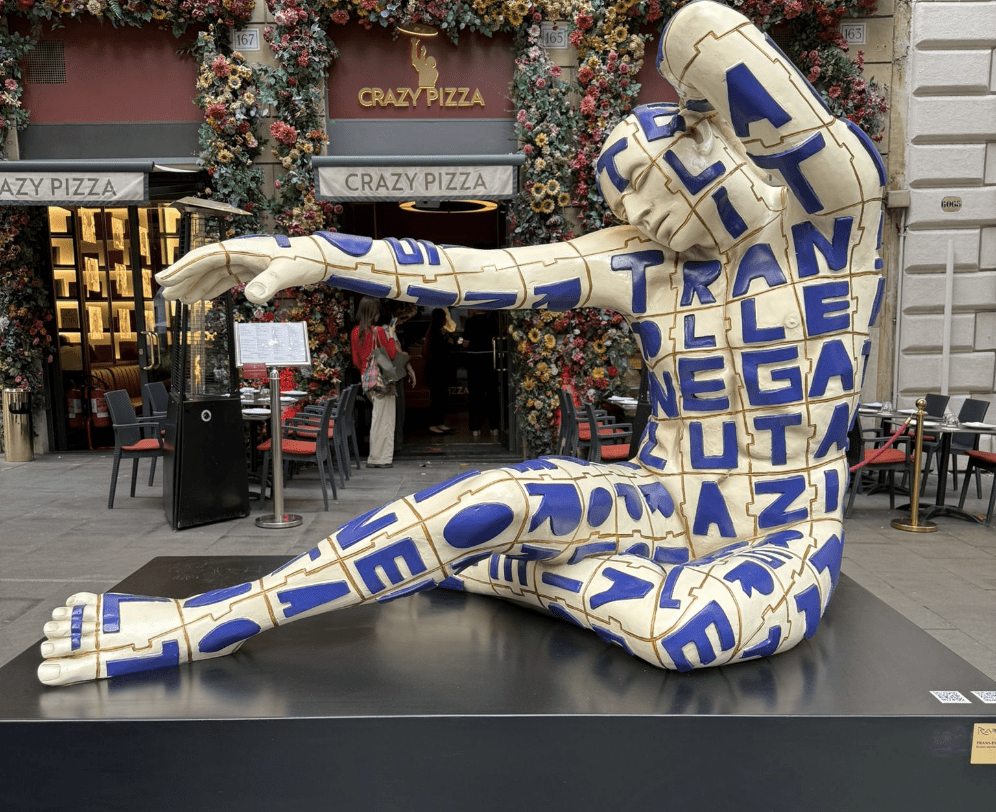
Each sculpture’s surface is covered in runes, geometric grids, references to the I Ching, and traces of numerology, a visual language developed across years of travel through Europe, Asia, and Latin America. The human body, in Rabarama’s practice, is not a subject so much as a writing surface: a place where identity and memory converge.
The show’s centrepiece is Madame Butterfly, an upturned kneeling figure drawn from Puccini’s heroine, built around the theme of letting go. For Rabarama, the project is a direct response to what she sees as a global drift toward dehumanisation. The statues are her way of reasserting the human body, and the human being, as worthy of central attention.
The exhibition is the fourth that the Associazione Via Veneto, a residents-and-business group founded in 2018, has staged along the street. Its president, Elisabetta Calò, knows what is at stake. When the Café de Paris palazzo was sold 15 years ago, it took around 10 businesses with it; the building stands empty to this day, and the street has yet to recover.
Rome’s First Municipality has backed the show as part of a broader effort to draw residents back into the historic centre. “Contemporary art forces you to stop, to reappropriate your own time, and to smile,” said Giulia Silvia Chia, Councillor for Culture.
Art with a purpose
Behind the production is PhilArt, a Bologna venture whose model channels commercial success directly into social purpose: a share of every sale funds Blue Butterfly, a foundation that uses music therapy and poetry with autistic children. Each large work takes as long as a year and a team of seven or eight artisans to complete.
Rabarama has exhibited in Paris, Cannes, Miami, Shanghai, and Beijing. Armonie del corpo is her most prominent intervention in her home city to date.