ROME — The RVO exhibition at Spazio Supernova on Piazza Santa Maria in Trastevere closes on July 15, 2026, giving visitors a final week to see how artists Luca Di Luzio and Edoardo Servadio turn Rome’s relationship with the Tiber into contemporary art.
The title RVO takes up the ancient Etruscan name of the Tiber, Rumen, as attested by the fourth-century grammarian Servius Marius Honoratus; it derives from the Indo-European root ruo or rhuo, meaning “to flow.” For the Greek philosopher Heraclitus of Ephesus, the flowing of a river was the very metaphor of time.
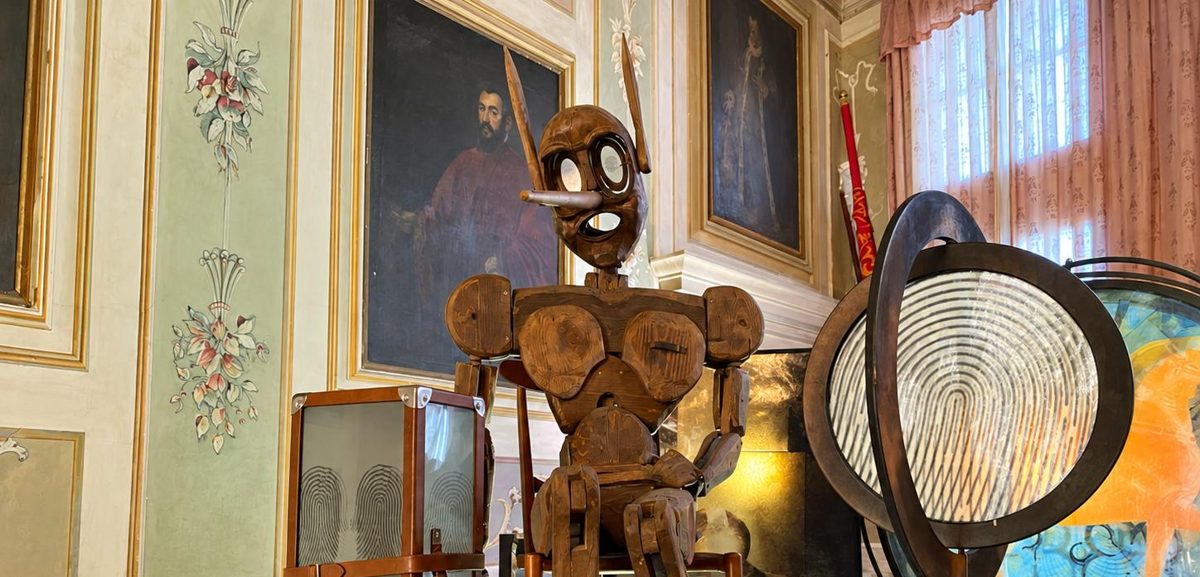
Curated by Fabio Sindici, the show gathers work by Di Luzio, a Roman artist born in 1986, and Servadio, who reworks ancient Latin inscriptions on modern aluminium and iron. The pieces climb several levels of the space, echoing the layers of the city itself.
The two artists began tracking the river in 2016. The Tiber was known in antiquity as Rumen, a name whose ancient root carries the verb “to flow” — an idea they took literally, hunting the city for the flood markers known as manine, or little hands.
“The river, the city, and time bind together in a route where the artists searched the streets, squares, and alleys of Rome for the inscriptions, plaques, and symbols that record the river’s floods,” said Fabio Sindici, the exhibition’s curator. “The last one came in 1937.”
Metal and memory
Di Luzio focuses on marks and bodily imprints that recall the work of Alighiero Boetti, the Italian conceptual artist. In 2022 he was a finalist for the Cairo Prize, a national award for emerging Italian artists. Servadio blends childhood memories of Japan with Greek, Etruscan, and Roman traditions, reworking Latin lettering carved in stone to rethink how a city marks its own streets.
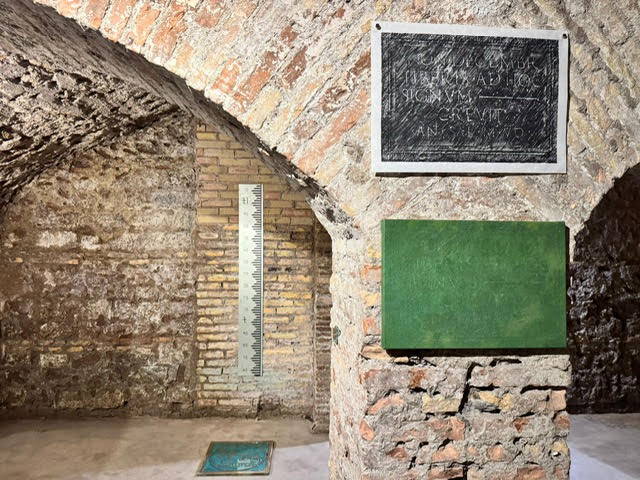
The carved markers, set into walls from the medieval period until Rome built its river embankments, record how high the flood water once climbed. The show binds Di Luzio’s chromatic reflections to the historical weight of Servadio’s sculptures, drawing on old myths, place names, and archaeological fragments. Some works are made jointly, four hands on one piece, where the two registers merge. Throughout, the exhibition keeps a steady play between fact and invention, urging visitors to look closely at every single wall.
Time as water
“The Tiber, like every river, is a strange genius,” said Rosaria Basilleo, a restorer and expert in ancient art. “The show rebuilds its flood gauges on paper and stone, marks left by history to record Rome’s floods.”
By turning fragments of the past into a present reflection, RVO leaves visitors watching time move the way the Tiber itself does, steadily and without pause. History, science, and visual poetry meet in the same current.